

-
1 random
['rændəm]прил.random wall — стена, выложенная неправильными рядами
random number информ. — случайное число
Syn:Ant:•• -
2 random
'rændəm(done etc without any particular plan or system; irregular: The opinion poll was based on a random sample of adults.) aleatorio, casual; sin orden- randomly- at random
random adj (hecho) al azartr['rændəm]1 aleatorio,-a\SMALLIDIOMATIC EXPRESSION/SMALLat random al azarrandom access memory memoria de acceso directorandom ['rændəm] adj1) : fortuito, aleatorio2)at random : al azar♦ randomly advadj.• aleatorio (Matemática) adj.• escogido al azar adj.'rændəma) <testing/choice> al azar; < shot> hecho al azar; < bullet> perdido; < sample> aleatorio, seleccionado al azarb)['rændǝm]to hit out at random — dar* golpes a diestra y siniestra or (Esp) a diestro y siniestro
1. ADJ1) (=haphazard) [arrangement] hecho al azar2) (=capricious, indiscriminate) caprichosoa random shot — un disparo hecho sin apuntar, una bala perdida
3) (Statistics, Maths) [sample, distribution] aleatorio2.N3.CPDrandom access N — (Comput) acceso m aleatorio
random access memory N — (Comput) memoria f de acceso aleatorio
random number N — número m al azar
* * *['rændəm]a) <testing/choice> al azar; < shot> hecho al azar; < bullet> perdido; < sample> aleatorio, seleccionado al azarb)to hit out at random — dar* golpes a diestra y siniestra or (Esp) a diestro y siniestro
-
3 wall-to-random-bed
Макаров: стенка-слой неупорядоченной насадки -
4 generator
= gen, = gntr1) генератора) генерирующее устройство, устройство для создания или производства чего-либо; производящий объектб) вчт программное или аппаратное средство для создания или производства чего-либод) порождающий объект; порождающая функция2) формирующее устройство, формирователь•- acoustic generator
- ac tacho-generator
- action generator
- acyclic generator
- additive random number generator
- analog signal generator
- annular induction MHD generator
- application generator
- arbitrary function generator
- arbitrary waveform generator
- artwork generator
- audio signal generator
- audio-frequency signal generator
- balanced generator
- bar generator
- base generator
- bivariant function generator
- blanking pulse generator
- bootstrapped sawtooth generator
- bubble generator
- burst generator
- carrier generator
- character generator
- chirp generator
- code generator
- code-sequence generator
- color-bar generator
- command generator
- commutating-pole generator
- complex-wave generator
- constant-current generator
- crossed-field generator
- crosshatch generator
- cross-reference generator
- current generator
- cursor generator - DCW generator
- delay generator
- diagonal conducting wall generator
- digital delay generator
- digitally tunable generator
- diode function generator
- diverter pole generator
- dot generator
- dot-matrix character generator
- double-current generator
- driving generator
- E-beam pattern generator
- E-beam photomask generator
- electron-beam generator
- electron-beam pattern generator
- electronic generator
- electron-tube generator
- electrostatic generator
- equivalent noise generator
- expanded-sweep generator
- fixed-format dot generator
- fixed-format dot character generator
- font generator
- fuel-cell generator
- function generator
- functional block generator
- gate generator - gold-device pattern generator
- Hall generator
- hand generator
- harmonic generator
- heteropolar generator
- homopolar generator
- horizontal sweep generator
- impulse generator
- impulse-noise generator
- induction generator
- inductor generator - klystron generator
- laser image generator
- line-segment generator
- lower sideband generator
- macro generator
- magnetoelectric generator
- magnetohydrodynamic generator
- marker generator
- mask generator
- MHD generator
- MIDI sound generator
- modulated signal generator
- molecular generator
- m-sequence generator
- multilevel-interconnection generator
- natural-gas fueled generator
- negative-effective-mass generator
- negative-grid generator - noise-voltage generator
- nonequilibrium MHD generator - parity generator
- parser generator
- pattern generator
- phase generator
- phase-locked generator
- photoelectric pulse generator
- photomask generator
- photomask pattern generator
- photo-pattern generator
- PLA generator
- plasma generator
- program generator
- programmable logic array generator
- PR sequence generator - pseudo-random sequence generator
- pulse generator
- pulsed generator
- pulse-train generator
- radio-frequency signal generator
- rainbow generator
- ramp generator
- random impulse generator
- random noise generator - rate generator
- reference generator
- regenerative generator
- relaxation generator
- report generator
- RF generator
- sawtooth generator
- scanned keyboard tone generator
- scanner generator
- screen generator
- segmented electrode generator
- self-contained generator
- selsyn generator
- SH generator
- shading generator
- signal generator
- simulative generator
- sine-cosine generator
- sliding pulse generator
- software-simulator pattern generator
- solar generator
- sort generator
- sort/merge generator
- spark-gap generator
- speech generator
- square-law function generator
- square-wave generator
- staircase generator
- standard-frequency generator - step generator
- step-function generator
- stroke character generator
- stroke-format generator
- stroke-pattern character generator
- subaudio-frequency generator
- subharmonic generator
- surge generator
- sweep generator
- swept-frequency generator
- switch function generator
- switch-type function generator
- symbol generator
- sync generator - synchro differential generator
- synchronous generator - tandem pulse generator
- test-pattern generator
- thermal noise generator
- thermionic generator
- thermoelectric generator
- thermoelectric power generator
- time-base generator
- time code generator
- time-mark generator
- tone generator
- tone burst generator
- transferred-electron generator
- trapezoidal generator
- triangular generator
- trigger generator
- ultrasonic generator
- unipolar generator - variable-pulse generator
- variable-velocity MHD induction generator
- vertical sweep generator
- video generator
- voltage generator
- warble-tone generator
- waveform generator
- white noise generator
- wind-driven generator
- wing-spot generator
- word generator -
5 generator
1) генератора) генерирующее устройство, устройство для создания или производства чего-либо; производящий объектб) вчт. программное или аппаратное средство для создания или производства чего-либод) порождающий объект; порождающая функция2) формирующее устройство, формирователь•- ac tacho-generator
- acoustic generator
- action generator
- acyclic generator
- additive random number generator
- analog signal generator
- annular induction MHD generator
- application generator
- arbitrary function generator
- arbitrary waveform generator
- artwork generator
- audio signal generator
- audio-frequency signal generator
- balanced generator
- bar generator
- base generator
- bivariant function generator
- blanking pulse generator
- bootstrapped sawtooth generator
- bubble generator
- burst generator
- carrier generator
- character generator
- chirp generator
- code generator
- code-sequence generator
- color-bar generator
- command generator
- commutating-pole generator
- complex-wave generator
- constant-current generator
- crossed-field generator
- crosshatch generator
- cross-reference generator
- current generator
- cursor generator
- cyclic address generator
- dc generator
- DCW generator
- delay generator
- diagonal conducting wall generator
- digital delay generator
- digitally tunable generator
- diode function generator
- diverter pole generator
- dot generator
- dot-matrix character generator
- double-current generator
- driving generator
- E-beam pattern generator
- E-beam photomask generator
- electron-beam generator
- electron-beam pattern generator
- electronic generator
- electron-tube generator
- electrostatic generator
- equivalent noise generator
- expanded-sweep generator
- fixed-format dot character generator
- fixed-format dot generator
- font generator
- fuel-cell generator
- function generator
- functional block generator
- gate generator
- gate-pulse generator
- Gaussian noise generator
- gold-device pattern generator
- Hall generator
- hand generator
- harmonic generator
- heteropolar generator
- homopolar generator
- horizontal sweep generator
- impulse generator
- impulse-noise generator
- induction generator
- inductor generator
- integrated coherent infrared generator
- interference generator
- klystron generator
- laser image generator
- line-segment generator
- lower sideband generator
- macro generator
- magnetoelectric generator
- magnetohydrodynamic generator
- marker generator
- mask generator
- MHD generator
- MIDI sound generator
- modulated signal generator
- molecular generator
- m-sequence generator
- multilevel-interconnection generator
- natural-gas fueled generator
- negative-effective-mass generator
- negative-grid generator
- noise generator
- noise-current generator
- noise-voltage generator
- nonequilibrium MHD generator
- output generator
- parametric generator
- parity generator
- parser generator
- pattern generator
- phase generator
- phase-locked generator
- photoelectric pulse generator
- photomask generator
- photomask pattern generator
- photo-pattern generator
- PLA generator
- plasma generator
- PR sequence generator
- program generator
- programmable logic array generator
- pseudo-random number generator
- pseudo-random pattern generator
- pseudo-random sequence generator
- pulse generator
- pulsed generator
- pulse-train generator
- radio-frequency signal generator
- rainbow generator
- ramp generator
- random impulse generator
- random noise generator
- random number generator
- random pulse generator
- rate generator
- reference generator
- regenerative generator
- relaxation generator
- report generator
- RF generator
- sawtooth generator
- scanned keyboard tone generator
- scanner generator
- screen generator
- segmented electrode generator
- self-contained generator
- selsyn generator
- SH generator
- shading generator
- signal generator
- simulative generator
- sine-cosine generator
- sliding pulse generator
- software-simulator pattern generator
- solar generator
- sort generator
- sort/merge generator
- spark-gap generator
- speech generator
- square-law function generator
- square-wave generator
- staircase generator
- standard-frequency generator
- standard-signal generator
- standard-voltage generator
- step generator
- step-function generator
- stroke character generator
- stroke-format generator
- stroke-pattern character generator
- subaudio-frequency generator
- subharmonic generator
- surge generator
- sweep generator
- swept-frequency generator
- switch function generator
- switch-type function generator
- symbol generator
- sync generator
- synchro differential generator
- synchro generator
- synchronous command generator
- synchronous generator
- sync-pulse generator
- tacho-generator
- tandem pulse generator
- test-pattern generator
- thermal noise generator
- thermionic generator
- thermoelectric generator
- thermoelectric power generator
- time code generator
- time-base generator
- time-mark generator
- tone burst generator
- tone generator
- transferred-electron generator
- trapezoidal generator
- triangular generator
- trigger generator
- ultrasonic generator
- unipolar generator
- upper sideband generator
- variable-format dot character generator
- variable-pulse generator
- variable-velocity MHD induction generator
- vertical sweep generator
- video generator
- voltage generator
- warble-tone generator
- waveform generator
- white noise generator
- wind-driven generator
- wing-spot generator
- word generatorThe New English-Russian Dictionary of Radio-electronics > generator
-
6 Bibliography
■ Aitchison, J. (1987). Noam Chomsky: Consensus and controversy. New York: Falmer Press.■ Anderson, J. R. (1980). Cognitive psychology and its implications. San Francisco: W. H. Freeman.■ Anderson, J. R. (1983). The architecture of cognition. Cambridge, MA: Harvard University Press.■ Anderson, J. R. (1995). Cognitive psychology and its implications (4th ed.). New York: W. H. Freeman.■ Archilochus (1971). In M. L. West (Ed.), Iambi et elegi graeci (Vol. 1). Oxford: Oxford University Press.■ Armstrong, D. M. (1990). The causal theory of the mind. In W. G. Lycan (Ed.), Mind and cognition: A reader (pp. 37-47). Cambridge, MA: Basil Blackwell. (Originally published in 1981 in The nature of mind and other essays, Ithaca, NY: University Press).■ Atkins, P. W. (1992). Creation revisited. Oxford: W. H. Freeman & Company.■ Austin, J. L. (1962). How to do things with words. Cambridge, MA: Harvard University Press.■ Bacon, F. (1878). Of the proficience and advancement of learning divine and human. In The works of Francis Bacon (Vol. 1). Cambridge, MA: Hurd & Houghton.■ Bacon, R. (1928). Opus majus (Vol. 2). R. B. Burke (Trans.). Philadelphia, PA: University of Pennsylvania Press.■ Bar-Hillel, Y. (1960). The present status of automatic translation of languages. In F. L. Alt (Ed.), Advances in computers (Vol. 1). New York: Academic Press.■ Barr, A., & E. A. Feigenbaum (Eds.) (1981). The handbook of artificial intelligence (Vol. 1). Reading, MA: Addison-Wesley.■ Barr, A., & E. A. Feigenbaum (Eds.) (1982). The handbook of artificial intelligence (Vol. 2). Los Altos, CA: William Kaufman.■ Barron, F. X. (1963). The needs for order and for disorder as motives in creative activity. In C. W. Taylor & F. X. Barron (Eds.), Scientific creativity: Its rec ognition and development (pp. 153-160). New York: Wiley.■ Bartlett, F. C. (1932). Remembering: A study in experimental and social psychology. Cambridge: Cambridge University Press.■ Bartley, S. H. (1969). Principles of perception. London: Harper & Row.■ Barzun, J. (1959). The house of intellect. New York: Harper & Row.■ Beach, F. A., D. O. Hebb, C. T. Morgan & H. W. Nissen (Eds.) (1960). The neu ropsychology of Lashley. New York: McGraw-Hill.■ Berkeley, G. (1996). Principles of human knowledge: Three Dialogues. Oxford: Oxford University Press. (Originally published in 1710.)■ Berlin, I. (1953). The hedgehog and the fox: An essay on Tolstoy's view of history. NY: Simon & Schuster.■ Bierwisch, J. (1970). Semantics. In J. Lyons (Ed.), New horizons in linguistics. Baltimore: Penguin Books.■ Black, H. C. (1951). Black's law dictionary. St. Paul, MN: West Publishing.■ Bloom, A. (1981). The linguistic shaping of thought: A study in the impact of language on thinking in China and the West. Hillsdale, NJ: Erlbaum.■ Bobrow, D. G., & D. A. Norman (1975). Some principles of memory schemata. In D. G. Bobrow & A. Collins (Eds.), Representation and understanding: Stud ies in Cognitive Science (pp. 131-149). New York: Academic Press.■ Boden, M. A. (1977). Artificial intelligence and natural man. New York: Basic Books.■ Boden, M. A. (1981). Minds and mechanisms. Ithaca, NY: Cornell University Press.■ Boden, M. A. (1990a). The creative mind: Myths and mechanisms. London: Cardinal.■ Boden, M. A. (1990b). The philosophy of artificial intelligence. Oxford: Oxford University Press.■ Boden, M. A. (1994). Precis of The creative mind: Myths and mechanisms. Behavioral and brain sciences 17, 519-570.■ Boden, M. (1996). Creativity. In M. Boden (Ed.), Artificial Intelligence (2nd ed.). San Diego: Academic Press.■ Bolter, J. D. (1984). Turing's man: Western culture in the computer age. Chapel Hill, NC: University of North Carolina Press.■ Bolton, N. (1972). The psychology of thinking. London: Methuen.■ Bourne, L. E. (1973). Some forms of cognition: A critical analysis of several papers. In R. Solso (Ed.), Contemporary issues in cognitive psychology (pp. 313324). Loyola Symposium on Cognitive Psychology (Chicago 1972). Washington, DC: Winston.■ Bransford, J. D., N. S. McCarrell, J. J. Franks & K. E. Nitsch (1977). Toward unexplaining memory. In R. Shaw & J. D. Bransford (Eds.), Perceiving, acting, and knowing (pp. 431-466). Hillsdale, NJ: Lawrence Erlbaum Associates.■ Breger, L. (1981). Freud's unfinished journey. London: Routledge & Kegan Paul.■ Brehmer, B. (1986). In one word: Not from experience. In H. R. Arkes & K. Hammond (Eds.), Judgment and decision making: An interdisciplinary reader (pp. 705-719). Cambridge: Cambridge University Press.■ Bresnan, J. (1978). A realistic transformational grammar. In M. Halle, J. Bresnan & G. A. Miller (Eds.), Linguistic theory and psychological reality (pp. 1-59). Cambridge, MA: MIT Press.■ Brislin, R. W., W. J. Lonner & R. M. Thorndike (Eds.) (1973). Cross- cultural research methods. New York: Wiley.■ Bronowski, J. (1977). A sense of the future: Essays in natural philosophy. P. E. Ariotti with R. Bronowski (Eds.). Cambridge, MA: MIT Press.■ Bronowski, J. (1978). The origins of knowledge and imagination. New Haven, CT: Yale University Press.■ Brown, R. O. (1973). A first language: The early stages. Cambridge, MA: Harvard University Press.■ Brown, T. (1970). Lectures on the philosophy of the human mind. In R. Brown (Ed.), Between Hume and Mill: An anthology of British philosophy- 1749- 1843 (pp. 330-387). New York: Random House/Modern Library.■ Bruner, J. S., J. Goodnow & G. Austin (1956). A study of thinking. New York: Wiley.■ Calvin, W. H. (1990). The cerebral symphony: Seashore reflections on the structure of consciousness. New York: Bantam.■ Campbell, J. (1982). Grammatical man: Information, entropy, language, and life. New York: Simon & Schuster.■ Campbell, J. (1989). The improbable machine. New York: Simon & Schuster.■ Carlyle, T. (1966). On heroes, hero- worship and the heroic in history. Lincoln: University of Nebraska Press. (Originally published in 1841.)■ Carnap, R. (1959). The elimination of metaphysics through logical analysis of language [Ueberwindung der Metaphysik durch logische Analyse der Sprache]. In A. J. Ayer (Ed.), Logical positivism (pp. 60-81) A. Pap (Trans). New York: Free Press. (Originally published in 1932.)■ Cassirer, E. (1946). Language and myth. New York: Harper and Brothers. Reprinted. New York: Dover Publications, 1953.■ Cattell, R. B., & H. J. Butcher (1970). Creativity and personality. In P. E. Vernon (Ed.), Creativity. Harmondsworth, England: Penguin Books.■ Caudill, M., & C. Butler (1990). Naturally intelligent systems. Cambridge, MA: MIT Press/Bradford Books.■ Chandrasekaran, B. (1990). What kind of information processing is intelligence? A perspective on AI paradigms and a proposal. In D. Partridge & R. Wilks (Eds.), The foundations of artificial intelligence: A sourcebook (pp. 14-46). Cambridge: Cambridge University Press.■ Charniak, E., & McDermott, D. (1985). Introduction to artificial intelligence. Reading, MA: Addison-Wesley.■ Chase, W. G., & H. A. Simon (1988). The mind's eye in chess. In A. Collins & E. E. Smith (Eds.), Readings in cognitive science: A perspective from psychology and artificial intelligence (pp. 461-493). San Mateo, CA: Kaufmann.■ Cheney, D. L., & R. M. Seyfarth (1990). How monkeys see the world: Inside the mind of another species. Chicago: University of Chicago Press.■ Chi, M.T.H., R. Glaser & E. Rees (1982). Expertise in problem solving. In R. J. Sternberg (Ed.), Advances in the psychology of human intelligence (pp. 7-73). Hillsdale, NJ: Lawrence Erlbaum Associates.■ Chomsky, N. (1957). Syntactic structures. The Hague: Mouton. Janua Linguarum.■ Chomsky, N. (1964). A transformational approach to syntax. In J. A. Fodor & J. J. Katz (Eds.), The structure of language: Readings in the philosophy of lan guage (pp. 211-245). Englewood Cliffs, NJ: Prentice-Hall.■ Chomsky, N. (1965). Aspects of the theory of syntax. Cambridge, MA: MIT Press.■ Chomsky, N. (1972). Language and mind (enlarged ed.). New York: Harcourt Brace Jovanovich.■ Chomsky, N. (1979). Language and responsibility. New York: Pantheon.■ Chomsky, N. (1986). Knowledge of language: Its nature, origin and use. New York: Praeger Special Studies.■ Churchland, P. (1979). Scientific realism and the plasticity of mind. New York: Cambridge University Press.■ Churchland, P. M. (1989). A neurocomputational perspective: The nature of mind and the structure of science. Cambridge, MA: MIT Press.■ Churchland, P. S. (1986). Neurophilosophy. Cambridge, MA: MIT Press/Bradford Books.■ Clark, A. (1996). Philosophical Foundations. In M. A. Boden (Ed.), Artificial in telligence (2nd ed.). San Diego: Academic Press.■ Clark, H. H., & T. B. Carlson (1981). Context for comprehension. In J. Long & A. Baddeley (Eds.), Attention and performance (Vol. 9, pp. 313-330). Hillsdale, NJ: Lawrence Erlbaum Associates.■ Clarke, A. C. (1984). Profiles of the future: An inquiry into the limits of the possible. New York: Holt, Rinehart & Winston.■ Claxton, G. (1980). Cognitive psychology: A suitable case for what sort of treatment? In G. Claxton (Ed.), Cognitive psychology: New directions (pp. 1-25). London: Routledge & Kegan Paul.■ Code, M. (1985). Order and organism. Albany, NY: State University of New York Press.■ Collingwood, R. G. (1972). The idea of history. New York: Oxford University Press.■ Coopersmith, S. (1967). The antecedents of self- esteem. San Francisco: W. H. Freeman.■ Copland, A. (1952). Music and imagination. London: Oxford University Press.■ Coren, S. (1994). The intelligence of dogs. New York: Bantam Books.■ Cottingham, J. (Ed.) (1996). Western philosophy: An anthology. Oxford: Blackwell Publishers.■ Cox, C. (1926). The early mental traits of three hundred geniuses. Stanford, CA: Stanford University Press.■ Craik, K.J.W. (1943). The nature of explanation. Cambridge: Cambridge University Press.■ Cronbach, L. J. (1990). Essentials of psychological testing (5th ed.). New York: HarperCollins.■ Cronbach, L. J., & R. E. Snow (1977). Aptitudes and instructional methods. New York: Irvington. Paperback edition, 1981.■ Csikszentmihalyi, M. (1993). The evolving self. New York: Harper Perennial.■ Culler, J. (1976). Ferdinand de Saussure. New York: Penguin Books.■ Curtius, E. R. (1973). European literature and the Latin Middle Ages. W. R. Trask (Trans.). Princeton, NJ: Princeton University Press.■ D'Alembert, J.L.R. (1963). Preliminary discourse to the encyclopedia of Diderot. R. N. Schwab (Trans.). Indianapolis: Bobbs-Merrill.■ Dampier, W. C. (1966). A history of modern science. Cambridge: Cambridge University Press.■ Darwin, C. (1911). The life and letters of Charles Darwin (Vol. 1). Francis Darwin (Ed.). New York: Appleton.■ Davidson, D. (1970) Mental events. In L. Foster & J. W. Swanson (Eds.), Experience and theory (pp. 79-101). Amherst: University of Massachussetts Press.■ Davies, P. (1995). About time: Einstein's unfinished revolution. New York: Simon & Schuster/Touchstone.■ Davis, R., & J. J. King (1977). An overview of production systems. In E. Elcock & D. Michie (Eds.), Machine intelligence 8. Chichester, England: Ellis Horwood.■ Davis, R., & D. B. Lenat (1982). Knowledge- based systems in artificial intelligence. New York: McGraw-Hill.■ Dawkins, R. (1982). The extended phenotype: The gene as the unit of selection. Oxford: W. H. Freeman.■ deKleer, J., & J. S. Brown (1983). Assumptions and ambiguities in mechanistic mental models (1983). In D. Gentner & A. L. Stevens (Eds.), Mental modes (pp. 155-190). Hillsdale, NJ: Lawrence Erlbaum Associates.■ Dennett, D. C. (1978a). Brainstorms: Philosophical essays on mind and psychology. Montgomery, VT: Bradford Books.■ Dennett, D. C. (1978b). Toward a cognitive theory of consciousness. In D. C. Dennett, Brainstorms: Philosophical Essays on Mind and Psychology. Montgomery, VT: Bradford Books.■ Dennett, D. C. (1995). Darwin's dangerous idea: Evolution and the meanings of life. New York: Simon & Schuster/Touchstone.■ Descartes, R. (1897-1910). Traite de l'homme. In Oeuvres de Descartes (Vol. 11, pp. 119-215). Paris: Charles Adam & Paul Tannery. (Originally published in 1634.)■ Descartes, R. (1950). Discourse on method. L. J. Lafleur (Trans.). New York: Liberal Arts Press. (Originally published in 1637.)■ Descartes, R. (1951). Meditation on first philosophy. L. J. Lafleur (Trans.). New York: Liberal Arts Press. (Originally published in 1641.)■ Descartes, R. (1955). The philosophical works of Descartes. E. S. Haldane and G.R.T. Ross (Trans.). New York: Dover. (Originally published in 1911 by Cambridge University Press.)■ Descartes, R. (1967). Discourse on method (Pt. V). In E. S. Haldane and G.R.T. Ross (Eds.), The philosophical works of Descartes (Vol. 1, pp. 106-118). Cambridge: Cambridge University Press. (Originally published in 1637.)■ Descartes, R. (1970a). Discourse on method. In E. S. Haldane & G.R.T. Ross (Eds.), The philosophical works of Descartes (Vol. 1, pp. 181-200). Cambridge: Cambridge University Press. (Originally published in 1637.)■ Descartes, R. (1970b). Principles of philosophy. In E. S. Haldane & G.R.T. Ross (Eds.), The philosophical works of Descartes (Vol. 1, pp. 178-291). Cambridge: Cambridge University Press. (Originally published in 1644.)■ Descartes, R. (1984). Meditations on first philosophy. In J. Cottingham, R. Stoothoff & D. Murduch (Trans.), The philosophical works of Descartes (Vol. 2). Cambridge: Cambridge University Press. (Originally published in 1641.)■ Descartes, R. (1986). Meditations on first philosophy. J. Cottingham (Trans.). Cambridge: Cambridge University Press. (Originally published in 1641 as Med itationes de prima philosophia.)■ deWulf, M. (1956). An introduction to scholastic philosophy. Mineola, NY: Dover Books.■ Dixon, N. F. (1981). Preconscious processing. London: Wiley.■ Doyle, A. C. (1986). The Boscombe Valley mystery. In Sherlock Holmes: The com plete novels and stories (Vol. 1). New York: Bantam.■ Dreyfus, H., & S. Dreyfus (1986). Mind over machine. New York: Free Press.■ Dreyfus, H. L. (1972). What computers can't do: The limits of artificial intelligence (revised ed.). New York: Harper & Row.■ Dreyfus, H. L., & S. E. Dreyfus (1986). Mind over machine: The power of human intuition and expertise in the era of the computer. New York: Free Press.■ Edelman, G. M. (1992). Bright air, brilliant fire: On the matter of the mind. New York: Basic Books.■ Ehrenzweig, A. (1967). The hidden order of art. London: Weidenfeld & Nicolson.■ Einstein, A., & L. Infeld (1938). The evolution of physics. New York: Simon & Schuster.■ Eisenstein, S. (1947). Film sense. New York: Harcourt, Brace & World.■ Everdell, W. R. (1997). The first moderns. Chicago: University of Chicago Press.■ Eysenck, M. W. (1977). Human memory: Theory, research and individual difference. Oxford: Pergamon.■ Eysenck, M. W. (1982). Attention and arousal: Cognition and performance. Berlin: Springer.■ Eysenck, M. W. (1984). A handbook of cognitive psychology. Hillsdale, NJ: Lawrence Erlbaum Associates.■ Fancher, R. E. (1979). Pioneers of psychology. New York: W. W. Norton.■ Farrell, B. A. (1981). The standing of psychoanalysis. New York: Oxford University Press.■ Feldman, D. H. (1980). Beyond universals in cognitive development. Norwood, NJ: Ablex.■ Fetzer, J. H. (1996). Philosophy and cognitive science (2nd ed.). New York: Paragon House.■ Finke, R. A. (1990). Creative imagery: Discoveries and inventions in visualization. Hillsdale, NJ: Lawrence Erlbaum Associates.■ Flanagan, O. (1991). The science of the mind. Cambridge MA: MIT Press/Bradford Books.■ Fodor, J. (1983). The modularity of mind. Cambridge, MA: MIT Press/Bradford Books.■ Frege, G. (1972). Conceptual notation. T. W. Bynum (Trans.). Oxford: Clarendon Press. (Originally published in 1879.)■ Frege, G. (1979). Logic. In H. Hermes, F. Kambartel & F. Kaulbach (Eds.), Gottlob Frege: Posthumous writings. Chicago: University of Chicago Press. (Originally published in 1879-1891.)■ Freud, S. (1959). Creative writers and day-dreaming. In J. Strachey (Ed.), The standard edition of the complete psychological works of Sigmund Freud (Vol. 9, pp. 143-153). London: Hogarth Press.■ Freud, S. (1966). Project for a scientific psychology. In J. Strachey (Ed.), The stan dard edition of the complete psychological works of Sigmund Freud (Vol. 1, pp. 295-398). London: Hogarth Press. (Originally published in 1950 as Aus den AnfaЁngen der Psychoanalyse, in London by Imago Publishing.)■ Freud, S. (1976). Lecture 18-Fixation to traumas-the unconscious. In J. Strachey (Ed.), The standard edition of the complete psychological works of Sigmund Freud (Vol. 16, p. 285). London: Hogarth Press.■ Galileo, G. (1990). Il saggiatore [The assayer]. In S. Drake (Ed.), Discoveries and opinions of Galileo. New York: Anchor Books. (Originally published in 1623.)■ Gassendi, P. (1970). Letter to Descartes. In "Objections and replies." In E. S. Haldane & G.R.T. Ross (Eds.), The philosophical works of Descartes (Vol. 2, pp. 179-240). Cambridge: Cambridge University Press. (Originally published in 1641.)■ Gazzaniga, M. S. (1988). Mind matters: How mind and brain interact to create our conscious lives. Boston: Houghton Mifflin in association with MIT Press/Bradford Books.■ Genesereth, M. R., & N. J. Nilsson (1987). Logical foundations of artificial intelligence. Palo Alto, CA: Morgan Kaufmann.■ Ghiselin, B. (1952). The creative process. New York: Mentor.■ Ghiselin, B. (1985). The creative process. Berkeley, CA: University of California Press. (Originally published in 1952.)■ Gilhooly, K. J. (1996). Thinking: Directed, undirected and creative (3rd ed.). London: Academic Press.■ Glass, A. L., K. J. Holyoak & J. L. Santa (1979). Cognition. Reading, MA: AddisonWesley.■ Goody, J. (1977). The domestication of the savage mind. Cambridge: Cambridge University Press.■ Gruber, H. E. (1980). Darwin on man: A psychological study of scientific creativity (2nd ed.). Chicago: University of Chicago Press.■ Gruber, H. E., & S. Davis (1988). Inching our way up Mount Olympus: The evolving systems approach to creative thinking. In R. J. Sternberg (Ed.), The nature of creativity: Contemporary psychological perspectives. Cambridge: Cambridge University Press.■ Guthrie, E. R. (1972). The psychology of learning. New York: Harper. (Originally published in 1935.)■ Habermas, J. (1972). Knowledge and human interests. Boston: Beacon Press.■ Hadamard, J. (1945). The psychology of invention in the mathematical field. Princeton, NJ: Princeton University Press.■ Hand, D. J. (1985). Artificial intelligence and psychiatry. Cambridge: Cambridge University Press.■ Harris, M. (1981). The language myth. London: Duckworth.■ Haugeland, J. (Ed.) (1981). Mind design: Philosophy, psychology, artificial intelligence. Cambridge, MA: MIT Press/Bradford Books.■ Haugeland, J. (1981a). The nature and plausibility of cognitivism. In J. Haugeland (Ed.), Mind design: Philosophy, psychology, artificial intelligence (pp. 243-281). Cambridge, MA: MIT Press.■ Haugeland, J. (1981b). Semantic engines: An introduction to mind design. In J. Haugeland (Ed.), Mind design: Philosophy, psychology, artificial intelligence (pp. 1-34). Cambridge, MA: MIT Press/Bradford Books.■ Haugeland, J. (1985). Artificial intelligence: The very idea. Cambridge, MA: MIT Press.■ Hawkes, T. (1977). Structuralism and semiotics. Berkeley: University of California Press.■ Hebb, D. O. (1949). The organisation of behaviour. New York: Wiley.■ Hebb, D. O. (1958). A textbook of psychology. Philadelphia: Saunders.■ Hegel, G.W.F. (1910). The phenomenology of mind. J. B. Baille (Trans.). London: Sonnenschein. (Originally published as Phaenomenologie des Geistes, 1807.)■ Heisenberg, W. (1958). Physics and philosophy. New York: Harper & Row.■ Hempel, C. G. (1966). Philosophy of natural science. Englewood Cliffs, NJ: PrenticeHall.■ Herman, A. (1997). The idea of decline in Western history. New York: Free Press.■ Herrnstein, R. J., & E. G. Boring (Eds.) (1965). A source book in the history of psy chology. Cambridge, MA: Harvard University Press.■ Herzmann, E. (1964). Mozart's creative process. In P. H. Lang (Ed.), The creative world of Mozart (pp. 17-30). London: Oldbourne Press.■ Hilgard, E. R. (1957). Introduction to psychology. London: Methuen.■ Hobbes, T. (1651). Leviathan. London: Crooke.■ Holliday, S. G., & M. J. Chandler (1986). Wisdom: Explorations in adult competence. Basel, Switzerland: Karger.■ Horn, J. L. (1986). In R. J. Sternberg (Ed.), Advances in the psychology of human intelligence (Vol. 3). Hillsdale, NJ: Erlbaum.■ Hull, C. (1943). Principles of behavior. New York: Appleton-Century-Crofts.■ Hume, D. (1955). An inquiry concerning human understanding. New York: Liberal Arts Press. (Originally published in 1748.)■ Hume, D. (1975). An enquiry concerning human understanding. In L. A. SelbyBigge (Ed.), Hume's enquiries (3rd. ed., revised P. H. Nidditch). Oxford: Clarendon. (Spelling and punctuation revised.) (Originally published in 1748.)■ Hume, D. (1978). A treatise of human nature. L. A. Selby-Bigge (Ed.), Hume's enquiries (3rd. ed., revised P. H. Nidditch). Oxford: Clarendon. (With some modifications of spelling and punctuation.) (Originally published in 1690.)■ Hunt, E. (1973). The memory we must have. In R. C. Schank & K. M. Colby (Eds.), Computer models of thought and language. (pp. 343-371) San Francisco: W. H. Freeman.■ Husserl, E. (1960). Cartesian meditations. The Hague: Martinus Nijhoff.■ Inhelder, B., & J. Piaget (1958). The growth of logical thinking from childhood to adolescence. New York: Basic Books. (Originally published in 1955 as De la logique de l'enfant a` la logique de l'adolescent. [Paris: Presses Universitaire de France])■ James, W. (1890a). The principles of psychology (Vol. 1). New York: Dover Books.■ James, W. (1890b). The principles of psychology. New York: Henry Holt.■ Jevons, W. S. (1900). The principles of science (2nd ed.). London: Macmillan.■ Johnson, G. (1986). Machinery of the mind: Inside the new science of artificial intelli gence. New York: Random House.■ Johnson-Laird, P. N. (1983). Mental models: Toward a cognitive science of language, inference, and consciousness. Cambridge, MA: Harvard University Press.■ Johnson-Laird, P. N. (1988). The computer and the mind: An introduction to cognitive science. Cambridge, MA: Harvard University Press.■ Jones, E. (1961). The life and work of Sigmund Freud. L. Trilling & S. Marcus (Eds.). London: Hogarth.■ Jones, R. V. (1985). Complementarity as a way of life. In A. P. French & P. J. Kennedy (Eds.), Niels Bohr: A centenary volume. Cambridge, MA: Harvard University Press.■ Kant, I. (1933). Critique of Pure Reason (2nd ed.). N. K. Smith (Trans.). London: Macmillan. (Originally published in 1781 as Kritik der reinen Vernunft.)■ Kant, I. (1891). Solution of the general problems of the Prolegomena. In E. Belfort (Trans.), Kant's Prolegomena. London: Bell. (With minor modifications.) (Originally published in 1783.)■ Katona, G. (1940). Organizing and memorizing: Studies in the psychology of learning and teaching. New York: Columbia University Press.■ Kaufman, A. S. (1979). Intelligent testing with the WISC-R. New York: Wiley.■ Koestler, A. (1964). The act of creation. New York: Arkana (Penguin).■ Kohlberg, L. (1971). From is to ought. In T. Mischel (Ed.), Cognitive development and epistemology. (pp. 151-235) New York: Academic Press.■ KoЁhler, W. (1925). The mentality of apes. New York: Liveright.■ KoЁhler, W. (1927). The mentality of apes (2nd ed.). Ella Winter (Trans.). London: Routledge & Kegan Paul.■ KoЁhler, W. (1930). Gestalt psychology. London: G. Bell.■ KoЁhler, W. (1947). Gestalt psychology. New York: Liveright.■ KoЁhler, W. (1969). The task of Gestalt psychology. Princeton, NJ: Princeton University Press.■ Kuhn, T. (1970). The structure of scientific revolutions (2nd ed.). Chicago: University of Chicago Press.■ Langer, E. J. (1989). Mindfulness. Reading, MA: Addison-Wesley.■ Langer, S. (1962). Philosophical sketches. Baltimore: Johns Hopkins University Press.■ Langley, P., H. A. Simon, G. L. Bradshaw & J. M. Zytkow (1987). Scientific dis covery: Computational explorations of the creative process. Cambridge, MA: MIT Press.■ Lashley, K. S. (1951). The problem of serial order in behavior. In L. A. Jeffress (Ed.), Cerebral mechanisms in behavior, the Hixon Symposium (pp. 112-146) New York: Wiley.■ LeDoux, J. E., & W. Hirst (1986). Mind and brain: Dialogues in cognitive neuroscience. Cambridge: Cambridge University Press.■ Lehnert, W. (1978). The process of question answering. Hillsdale, NJ: Lawrence Erlbaum Associates.■ Leiber, J. (1991). Invitation to cognitive science. Oxford: Blackwell.■ Lenat, D. B., & G. Harris (1978). Designing a rule system that searches for scientific discoveries. In D. A. Waterman & F. Hayes-Roth (Eds.), Pattern directed inference systems (pp. 25-52) New York: Academic Press.■ Levenson, T. (1995). Measure for measure: A musical history of science. New York: Touchstone. (Originally published in 1994.)■ Leґvi-Strauss, C. (1963). Structural anthropology. C. Jacobson & B. Grundfest Schoepf (Trans.). New York: Basic Books. (Originally published in 1958.)■ Levine, M. W., & J. M. Schefner (1981). Fundamentals of sensation and perception. London: Addison-Wesley.■ Lewis, C. I. (1946). An analysis of knowledge and valuation. LaSalle, IL: Open Court.■ Lighthill, J. (1972). A report on artificial intelligence. Unpublished manuscript, Science Research Council.■ Lipman, M., A. M. Sharp & F. S. Oscanyan (1980). Philosophy in the classroom. Philadelphia: Temple University Press.■ Lippmann, W. (1965). Public opinion. New York: Free Press. (Originally published in 1922.)■ Locke, J. (1956). An essay concerning human understanding. Chicago: Henry Regnery Co. (Originally published in 1690.)■ Locke, J. (1975). An essay concerning human understanding. P. H. Nidditch (Ed.). Oxford: Clarendon. (Originally published in 1690.) (With spelling and punctuation modernized and some minor modifications of phrasing.)■ Lopate, P. (1994). The art of the personal essay. New York: Doubleday/Anchor Books.■ Lorimer, F. (1929). The growth of reason. London: Kegan Paul. Machlup, F., & U. Mansfield (Eds.) (1983). The study of information. New York: Wiley.■ Manguel, A. (1996). A history of reading. New York: Viking.■ Markey, J. F. (1928). The symbolic process. London: Kegan Paul.■ Martin, R. M. (1969). On Ziff's "Natural and formal languages." In S. Hook (Ed.), Language and philosophy: A symposium (pp. 249-263). New York: New York University Press.■ Mazlish, B. (1993). The fourth discontinuity: the co- evolution of humans and machines. New Haven, CT: Yale University Press.■ McCarthy, J., & P. J. Hayes (1969). Some philosophical problems from the standpoint of artificial intelligence. In B. Meltzer & D. Michie (Eds.), Machine intelligence 4. Edinburgh: Edinburgh University Press.■ McClelland, J. L., D. E. Rumelhart & G. E. Hinton (1986). The appeal of parallel distributed processing. In D. E. Rumelhart, J. L. McClelland & the PDP Research Group (Eds.), Parallel distributed processing: Explorations in the mi crostructure of cognition (Vol. 1, pp. 3-40). Cambridge, MA: MIT Press/ Bradford Books.■ McCorduck, P. (1979). Machines who think. San Francisco: W. H. Freeman.■ McLaughlin, T. (1970). Music and communication. London: Faber & Faber.■ Mednick, S. A. (1962). The associative basis of the creative process. Psychological Review 69, 431-436.■ Meehl, P. E., & C. J. Golden (1982). Taxometric methods. In Kendall, P. C., & Butcher, J. N. (Eds.), Handbook of research methods in clinical psychology (pp. 127-182). New York: Wiley.■ Mehler, J., E.C.T. Walker & M. Garrett (Eds.) (1982). Perspectives on mental rep resentation: Experimental and theoretical studies of cognitive processes and ca pacities. Hillsdale, NJ: Lawrence Erlbaum Associates.■ Mill, J. S. (1900). A system of logic, ratiocinative and inductive: Being a connected view of the principles of evidence and the methods of scientific investigation. London: Longmans, Green.■ Miller, G. A. (1979, June). A very personal history. Talk to the Cognitive Science Workshop, Cambridge, MA.■ Miller, J. (1983). States of mind. New York: Pantheon Books.■ Minsky, M. (1975). A framework for representing knowledge. In P. H. Winston (Ed.), The psychology of computer vision (pp. 211-277). New York: McGrawHill.■ Minsky, M., & S. Papert (1973). Artificial intelligence. Condon Lectures, Oregon State System of Higher Education, Eugene, Oregon.■ Minsky, M. L. (1986). The society of mind. New York: Simon & Schuster.■ Mischel, T. (1976). Psychological explanations and their vicissitudes. In J. K. Cole & W. J. Arnold (Eds.), Nebraska Symposium on motivation (Vol. 23). Lincoln, NB: University of Nebraska Press.■ Morford, M.P.O., & R. J. Lenardon (1995). Classical mythology (5th ed.). New York: Longman.■ Murdoch, I. (1954). Under the net. New York: Penguin.■ Nagel, E. (1959). Methodological issues in psychoanalytic theory. In S. Hook (Ed.), Psychoanalysis, scientific method, and philosophy: A symposium. New York: New York University Press.■ Nagel, T. (1979). Mortal questions. London: Cambridge University Press.■ Nagel, T. (1986). The view from nowhere. Oxford: Oxford University Press.■ Neisser, U. (1967). Cognitive psychology. New York: Appleton-Century-Crofts.■ Neisser, U. (1972). Changing conceptions of imagery. In P. W. Sheehan (Ed.), The function and nature of imagery (pp. 233-251). London: Academic Press.■ Neisser, U. (1976). Cognition and reality. San Francisco: W. H. Freeman.■ Neisser, U. (1978). Memory: What are the important questions? In M. M. Gruneberg, P. E. Morris & R. N. Sykes (Eds.), Practical aspects of memory (pp. 3-24). London: Academic Press.■ Neisser, U. (1979). The concept of intelligence. In R. J. Sternberg & D. K. Detterman (Eds.), Human intelligence: Perspectives on its theory and measurement (pp. 179-190). Norwood, NJ: Ablex.■ Nersessian, N. (1992). How do scientists think? Capturing the dynamics of conceptual change in science. In R. N. Giere (Ed.), Cognitive models of science (pp. 3-44). Minneapolis: University of Minnesota Press.■ Newell, A. (1973a). Artificial intelligence and the concept of mind. In R. C. Schank & K. M. Colby (Eds.), Computer models of thought and language (pp. 1-60). San Francisco: W. H. Freeman.■ Newell, A. (1973b). You can't play 20 questions with nature and win. In W. G. Chase (Ed.), Visual information processing (pp. 283-310). New York: Academic Press.■ Newell, A., & H. A. Simon (1963). GPS: A program that simulates human thought. In E. A. Feigenbaum & J. Feldman (Eds.), Computers and thought (pp. 279-293). New York & McGraw-Hill.■ Newell, A., & H. A. Simon (1972). Human problem solving. Englewood Cliffs, NJ: Prentice-Hall.■ Nietzsche, F. (1966). Beyond good and evil. W. Kaufmann (Trans.). New York: Vintage. (Originally published in 1885.)■ Nilsson, N. J. (1971). Problem- solving methods in artificial intelligence. New York: McGraw-Hill.■ Nussbaum, M. C. (1978). Aristotle's Princeton University Press. De Motu Anamalium. Princeton, NJ:■ Oersted, H. C. (1920). Thermo-electricity. In Kirstine Meyer (Ed.), H. C. Oersted, Natuurvidenskabelige Skrifter (Vol. 2). Copenhagen: n.p. (Originally published in 1830 in The Edinburgh encyclopaedia.)■ Ong, W. J. (1982). Orality and literacy: The technologizing of the word. London: Methuen.■ Onians, R. B. (1954). The origins of European thought. Cambridge, MA: Cambridge University Press.■ Osgood, C. E. (1960). Method and theory in experimental psychology. New York: Oxford University Press. (Originally published in 1953.)■ Osgood, C. E. (1966). Language universals and psycholinguistics. In J. H. Greenberg (Ed.), Universals of language (2nd ed., pp. 299-322). Cambridge, MA: MIT Press.■ Palmer, R. E. (1969). Hermeneutics. Evanston, IL: Northwestern University Press.■ Peirce, C. S. (1934). Some consequences of four incapacities-Man, a sign. In C. Hartsborne & P. Weiss (Eds.), Collected papers of Charles Saunders Peirce (Vol. 5, pp. 185-189). Cambridge, MA: Harvard University Press.■ Penfield, W. (1959). In W. Penfield & L. Roberts, Speech and brain mechanisms. Princeton, NJ: Princeton University Press.■ Penrose, R. (1994). Shadows of the mind: A search for the missing science of conscious ness. Oxford: Oxford University Press.■ Perkins, D. N. (1981). The mind's best work. Cambridge, MA: Harvard University Press.■ Peterfreund, E. (1986). The heuristic approach to psychoanalytic therapy. In■ J. Reppen (Ed.), Analysts at work, (pp. 127-144). Hillsdale, NJ: Analytic Press.■ Piaget, J. (1952). The origin of intelligence in children. New York: International Universities Press. (Originally published in 1936.)■ Piaget, J. (1954). Le langage et les opeґrations intellectuelles. Proble` mes de psycho linguistique. Symposium de l'Association de Psychologie Scientifique de Langue Francёaise. Paris: Presses Universitaires de France.■ Piaget, J. (1977). Problems of equilibration. In H. E. Gruber & J. J. Voneche (Eds.), The essential Piaget (pp. 838-841). London: Routlege & Kegan Paul. (Originally published in 1975 as L'eґquilibration des structures cognitives [Paris: Presses Universitaires de France].)■ Piaget, J., & B. Inhelder. (1973). Memory and intelligence. New York: Basic Books.■ Pinker, S. (1994). The language instinct. New York: Morrow.■ Pinker, S. (1996). Facts about human language relevant to its evolution. In J.-P. Changeux & J. Chavaillon (Eds.), Origins of the human brain. A symposium of the Fyssen foundation (pp. 262-283). Oxford: Clarendon Press. Planck, M. (1949). Scientific autobiography and other papers. F. Gaynor (Trans.). New York: Philosophical Library.■ Planck, M. (1990). Wissenschaftliche Selbstbiographie. W. Berg (Ed.). Halle, Germany: Deutsche Akademie der Naturforscher Leopoldina.■ Plato (1892). Meno. In The Dialogues of Plato (B. Jowett, Trans.; Vol. 2). New York: Clarendon. (Originally published circa 380 B.C.)■ Poincareґ, H. (1913). Mathematical creation. In The foundations of science. G. B. Halsted (Trans.). New York: Science Press.■ Poincareґ, H. (1921). The foundations of science: Science and hypothesis, the value of science, science and method. G. B. Halstead (Trans.). New York: Science Press.■ Poincareґ, H. (1929). The foundations of science: Science and hypothesis, the value of science, science and method. New York: Science Press.■ Poincareґ, H. (1952). Science and method. F. Maitland (Trans.) New York: Dover.■ Polya, G. (1945). How to solve it. Princeton, NJ: Princeton University Press.■ Polanyi, M. (1958). Personal knowledge. London: Routledge & Kegan Paul.■ Popper, K. (1968). Conjectures and refutations: The growth of scientific knowledge. New York: Harper & Row/Basic Books.■ Popper, K., & J. Eccles (1977). The self and its brain. New York: Springer-Verlag.■ Popper, K. R. (1959). The logic of scientific discovery. London: Hutchinson.■ Putnam, H. (1975). Mind, language and reality: Philosophical papers (Vol. 2). Cambridge: Cambridge University Press.■ Putnam, H. (1987). The faces of realism. LaSalle, IL: Open Court.■ Pylyshyn, Z. W. (1981). The imagery debate: Analog media versus tacit knowledge. In N. Block (Ed.), Imagery (pp. 151-206). Cambridge, MA: MIT Press.■ Pylyshyn, Z. W. (1984). Computation and cognition: Towards a foundation for cog nitive science. Cambridge, MA: MIT Press/Bradford Books.■ Quillian, M. R. (1968). Semantic memory. In M. Minsky (Ed.), Semantic information processing (pp. 216-260). Cambridge, MA: MIT Press.■ Quine, W.V.O. (1960). Word and object. Cambridge, MA: Harvard University Press.■ Rabbitt, P.M.A., & S. Dornic (Eds.). Attention and performance (Vol. 5). London: Academic Press.■ Rawlins, G.J.E. (1997). Slaves of the Machine: The quickening of computer technology. Cambridge, MA: MIT Press/Bradford Books.■ Reid, T. (1970). An inquiry into the human mind on the principles of common sense. In R. Brown (Ed.), Between Hume and Mill: An anthology of British philosophy- 1749- 1843 (pp. 151-178). New York: Random House/Modern Library.■ Reitman, W. (1970). What does it take to remember? In D. A. Norman (Ed.), Models of human memory (pp. 470-510). London: Academic Press.■ Ricoeur, P. (1974). Structure and hermeneutics. In D. I. Ihde (Ed.), The conflict of interpretations: Essays in hermeneutics (pp. 27-61). Evanston, IL: Northwestern University Press.■ Robinson, D. N. (1986). An intellectual history of psychology. Madison: University of Wisconsin Press.■ Rorty, R. (1979). Philosophy and the mirror of nature. Princeton, NJ: Princeton University Press.■ Rosch, E. (1977). Human categorization. In N. Warren (Ed.), Studies in cross cultural psychology (Vol. 1, pp. 1-49) London: Academic Press.■ Rosch, E. (1978). Principles of categorization. In E. Rosch & B. B. Lloyd (Eds.), Cognition and categorization (pp. 27-48). Hillsdale, NJ: Lawrence Erlbaum Associates.■ Rosch, E., & B. B. Lloyd (1978). Principles of categorization. In E. Rosch & B. B. Lloyd (Eds.), Cognition and categorization. Hillsdale, NJ: Lawrence Erlbaum Associates.■ Rose, S. (1970). The chemistry of life. Baltimore: Penguin Books.■ Rose, S. (1976). The conscious brain (updated ed.). New York: Random House.■ Rose, S. (1993). The making of memory: From molecules to mind. New York: Anchor Books. (Originally published in 1992)■ Roszak, T. (1994). The cult of information: A neo- Luddite treatise on high- tech, artificial intelligence, and the true art of thinking (2nd ed.). Berkeley: University of California Press.■ Royce, J. R., & W. W. Rozeboom (Eds.) (1972). The psychology of knowing. New York: Gordon & Breach.■ Rumelhart, D. E. (1977). Introduction to human information processing. New York: Wiley.■ Rumelhart, D. E. (1980). Schemata: The building blocks of cognition. In R. J. Spiro, B. Bruce & W. F. Brewer (Eds.), Theoretical issues in reading comprehension. Hillsdale, NJ: Lawrence Erlbaum Associates.■ Rumelhart, D. E., & J. L. McClelland (1986). On learning the past tenses of English verbs. In J. L. McClelland & D. E. Rumelhart (Eds.), Parallel distributed processing: Explorations in the microstructure of cognition (Vol. 2). Cambridge, MA: MIT Press.■ Rumelhart, D. E., P. Smolensky, J. L. McClelland & G. E. Hinton (1986). Schemata and sequential thought processes in PDP models. In J. L. McClelland, D. E. Rumelhart & the PDP Research Group (Eds.), Parallel Distributed Processing (Vol. 2, pp. 7-57). Cambridge, MA: MIT Press.■ Russell, B. (1927). An outline of philosophy. London: G. Allen & Unwin.■ Russell, B. (1961). History of Western philosophy. London: George Allen & Unwin.■ Russell, B. (1965). How I write. In Portraits from memory and other essays. London: Allen & Unwin.■ Russell, B. (1992). In N. Griffin (Ed.), The selected letters of Bertrand Russell (Vol. 1), The private years, 1884- 1914. Boston: Houghton Mifflin. Ryecroft, C. (1966). Psychoanalysis observed. London: Constable.■ Sagan, C. (1978). The dragons of Eden: Speculations on the evolution of human intel ligence. New York: Ballantine Books.■ Salthouse, T. A. (1992). Expertise as the circumvention of human processing limitations. In K. A. Ericsson & J. Smith (Eds.), Toward a general theory of expertise: Prospects and limits (pp. 172-194). Cambridge: Cambridge University Press.■ Sanford, A. J. (1987). The mind of man: Models of human understanding. New Haven, CT: Yale University Press.■ Sapir, E. (1921). Language. New York: Harcourt, Brace, and World.■ Sapir, E. (1964). Culture, language, and personality. Berkeley: University of California Press. (Originally published in 1941.)■ Sapir, E. (1985). The status of linguistics as a science. In D. G. Mandelbaum (Ed.), Selected writings of Edward Sapir in language, culture and personality (pp. 160166). Berkeley: University of California Press. (Originally published in 1929).■ Scardmalia, M., & C. Bereiter (1992). Literate expertise. In K. A. Ericsson & J. Smith (Eds.), Toward a general theory of expertise: Prospects and limits (pp. 172-194). Cambridge: Cambridge University Press.■ Schafer, R. (1954). Psychoanalytic interpretation in Rorschach testing. New York: Grune & Stratten.■ Schank, R. C. (1973). Identification of conceptualizations underlying natural language. In R. C. Schank & K. M. Colby (Eds.), Computer models of thought and language (pp. 187-248). San Francisco: W. H. Freeman.■ Schank, R. C. (1976). The role of memory in language processing. In C. N. Cofer (Ed.), The structure of human memory. (pp. 162-189) San Francisco: W. H. Freeman.■ Schank, R. C. (1986). Explanation patterns: Understanding mechanically and creatively. Hillsdale, NJ: Lawrence Erlbaum Associates.■ Schank, R. C., & R. P. Abelson (1977). Scripts, plans, goals, and understanding. Hillsdale, NJ: Lawrence Erlbaum Associates.■ SchroЁdinger, E. (1951). Science and humanism. Cambridge: Cambridge University Press.■ Searle, J. R. (1981a). Minds, brains, and programs. In J. Haugeland (Ed.), Mind design: Philosophy, psychology, artificial intelligence (pp. 282-306). Cambridge, MA: MIT Press.■ Searle, J. R. (1981b). Minds, brains and programs. In D. Hofstadter & D. Dennett (Eds.), The mind's I (pp. 353-373). New York: Basic Books.■ Searle, J. R. (1983). Intentionality. New York: Cambridge University Press.■ Serres, M. (1982). The origin of language: Biology, information theory, and thermodynamics. M. Anderson (Trans.). In J. V. Harari & D. F. Bell (Eds.), Hermes: Literature, science, philosophy (pp. 71-83). Baltimore: Johns Hopkins University Press.■ Simon, H. A. (1966). Scientific discovery and the psychology of problem solving. In R. G. Colodny (Ed.), Mind and cosmos: Essays in contemporary science and philosophy (pp. 22-40). Pittsburgh: University of Pittsburgh Press.■ Simon, H. A. (1979). Models of thought. New Haven, CT: Yale University Press.■ Simon, H. A. (1989). The scientist as a problem solver. In D. Klahr & K. Kotovsky (Eds.), Complex information processing: The impact of Herbert Simon. Hillsdale, N.J.: Lawrence Erlbaum Associates.■ Simon, H. A., & C. Kaplan (1989). Foundations of cognitive science. In M. Posner (Ed.), Foundations of cognitive science (pp. 1-47). Cambridge, MA: MIT Press.■ Simonton, D. K. (1988). Creativity, leadership and chance. In R. J. Sternberg (Ed.), The nature of creativity. Cambridge: Cambridge University Press.■ Skinner, B. F. (1974). About behaviorism. New York: Knopf.■ Smith, E. E. (1988). Concepts and thought. In J. Sternberg & E. E. Smith (Eds.), The psychology of human thought (pp. 19-49). Cambridge: Cambridge University Press.■ Smith, E. E. (1990). Thinking: Introduction. In D. N. Osherson & E. E. Smith (Eds.), Thinking. An invitation to cognitive science. (Vol. 3, pp. 1-2). Cambridge, MA: MIT Press.■ Socrates. (1958). Meno. In E. H. Warmington & P. O. Rouse (Eds.), Great dialogues of Plato W.H.D. Rouse (Trans.). New York: New American Library. (Original publication date unknown.)■ Solso, R. L. (1974). Theories of retrieval. In R. L. Solso (Ed.), Theories in cognitive psychology. Potomac, MD: Lawrence Erlbaum Associates.■ Spencer, H. (1896). The principles of psychology. New York: Appleton-CenturyCrofts.■ Steiner, G. (1975). After Babel: Aspects of language and translation. New York: Oxford University Press.■ Sternberg, R. J. (1977). Intelligence, information processing, and analogical reasoning. Hillsdale, NJ: Lawrence Erlbaum Associates.■ Sternberg, R. J. (1994). Intelligence. In R. J. Sternberg, Thinking and problem solving. San Diego: Academic Press.■ Sternberg, R. J., & J. E. Davidson (1985). Cognitive development in gifted and talented. In F. D. Horowitz & M. O'Brien (Eds.), The gifted and talented (pp. 103-135). Washington, DC: American Psychological Association.■ Storr, A. (1993). The dynamics of creation. New York: Ballantine Books. (Originally published in 1972.)■ Stumpf, S. E. (1994). Philosophy: History and problems (5th ed.). New York: McGraw-Hill.■ Sulloway, F. J. (1996). Born to rebel: Birth order, family dynamics, and creative lives. New York: Random House/Vintage Books.■ Thorndike, E. L. (1906). Principles of teaching. New York: A. G. Seiler.■ Thorndike, E. L. (1970). Animal intelligence: Experimental studies. Darien, CT: Hafner Publishing Co. (Originally published in 1911.)■ Titchener, E. B. (1910). A textbook of psychology. New York: Macmillan.■ Titchener, E. B. (1914). A primer of psychology. New York: Macmillan.■ Toulmin, S. (1957). The philosophy of science. London: Hutchinson.■ Tulving, E. (1972). Episodic and semantic memory. In E. Tulving & W. Donaldson (Eds.), Organisation of memory. London: Academic Press.■ Turing, A. (1946). In B. E. Carpenter & R. W. Doran (Eds.), ACE reports of 1946 and other papers. Cambridge, MA: MIT Press.■ Turkle, S. (1984). Computers and the second self: Computers and the human spirit. New York: Simon & Schuster.■ Tyler, S. A. (1978). The said and the unsaid: Mind, meaning, and culture. New York: Academic Press.■ van Heijenoort (Ed.) (1967). From Frege to Goedel. Cambridge: Harvard University Press.■ Varela, F. J. (1984). The creative circle: Sketches on the natural history of circularity. In P. Watzlawick (Ed.), The invented reality (pp. 309-324). New York: W. W. Norton.■ Voltaire (1961). On the Penseґs of M. Pascal. In Philosophical letters (pp. 119-146). E. Dilworth (Trans.). Indianapolis: Bobbs-Merrill.■ Wagman, M. (1991a). Artificial intelligence and human cognition: A theoretical inter comparison of two realms of intellect. Westport, CT: Praeger.■ Wagman, M. (1991b). Cognitive science and concepts of mind: Toward a general theory of human and artificial intelligence. Westport, CT: Praeger.■ Wagman, M. (1993). Cognitive psychology and artificial intelligence: Theory and re search in cognitive science. Westport, CT: Praeger.■ Wagman, M. (1995). The sciences of cognition: Theory and research in psychology and artificial intelligence. Westport, CT: Praeger.■ Wagman, M. (1996). Human intellect and cognitive science: Toward a general unified theory of intelligence. Westport, CT: Praeger.■ Wagman, M. (1997a). Cognitive science and the symbolic operations of human and artificial intelligence: Theory and research into the intellective processes. Westport, CT: Praeger.■ Wagman, M. (1997b). The general unified theory of intelligence: Central conceptions and specific application to domains of cognitive science. Westport, CT: Praeger.■ Wagman, M. (1998a). Cognitive science and the mind- body problem: From philosophy to psychology to artificial intelligence to imaging of the brain. Westport, CT: Praeger.■ Wagman, M. (1998b). Language and thought in humans and computers: Theory and research in psychology, artificial intelligence, and neural science. Westport, CT: Praeger.■ Wagman, M. (1998c). The ultimate objectives of artificial intelligence: Theoretical and research foundations, philosophical and psychological implications. Westport, CT: Praeger.■ Wagman, M. (1999). The human mind according to artificial intelligence: Theory, re search, and implications. Westport, CT: Praeger.■ Wagman, M. (2000). Scientific discovery processes in humans and computers: Theory and research in psychology and artificial intelligence. Westport, CT: Praeger.■ Wall, R. (1972). Introduction to mathematical linguistics. Englewood Cliffs, NJ: Prentice-Hall.■ Wallas, G. (1926). The Art of Thought. New York: Harcourt, Brace & Co.■ Wason, P. (1977). Self contradictions. In P. Johnson-Laird & P. Wason (Eds.), Thinking: Readings in cognitive science. Cambridge: Cambridge University Press.■ Wason, P. C., & P. N. Johnson-Laird. (1972). Psychology of reasoning: Structure and content. Cambridge, MA: Harvard University Press.■ Watson, J. (1930). Behaviorism. New York: W. W. Norton.■ Watzlawick, P. (1984). Epilogue. In P. Watzlawick (Ed.), The invented reality. New York: W. W. Norton, 1984.■ Weinberg, S. (1977). The first three minutes: A modern view of the origin of the uni verse. New York: Basic Books.■ Weisberg, R. W. (1986). Creativity: Genius and other myths. New York: W. H. Freeman.■ Weizenbaum, J. (1976). Computer power and human reason: From judgment to cal culation. San Francisco: W. H. Freeman.■ Wertheimer, M. (1945). Productive thinking. New York: Harper & Bros.■ Whitehead, A. N. (1925). Science and the modern world. New York: Macmillan.■ Whorf, B. L. (1956). In J. B. Carroll (Ed.), Language, thought and reality: Selected writings of Benjamin Lee Whorf. Cambridge, MA: MIT Press.■ Whyte, L. L. (1962). The unconscious before Freud. New York: Anchor Books.■ Wiener, N. (1954). The human use of human beings. Boston: Houghton Mifflin.■ Wiener, N. (1964). God & Golem, Inc.: A comment on certain points where cybernetics impinges on religion. Cambridge, MA: MIT Press.■ Winograd, T. (1972). Understanding natural language. New York: Academic Press.■ Winston, P. H. (1987). Artificial intelligence: A perspective. In E. L. Grimson & R. S. Patil (Eds.), AI in the 1980s and beyond (pp. 1-12). Cambridge, MA: MIT Press.■ Winston, P. H. (Ed.) (1975). The psychology of computer vision. New York: McGrawHill.■ Wittgenstein, L. (1953). Philosophical investigations. Oxford: Basil Blackwell.■ Wittgenstein, L. (1958). The blue and brown books. New York: Harper Colophon.■ Woods, W. A. (1975). What's in a link: Foundations for semantic networks. In D. G. Bobrow & A. Collins (Eds.), Representations and understanding: Studies in cognitive science (pp. 35-84). New York: Academic Press.■ Woodworth, R. S. (1938). Experimental psychology. New York: Holt; London: Methuen (1939).■ Wundt, W. (1904). Principles of physiological psychology (Vol. 1). E. B. Titchener (Trans.). New York: Macmillan.■ Wundt, W. (1907). Lectures on human and animal psychology. J. E. Creighton & E. B. Titchener (Trans.). New York: Macmillan.■ Young, J. Z. (1978). Programs of the brain. New York: Oxford University Press.■ Ziman, J. (1978). Reliable knowledge: An exploration of the grounds for belief in science. Cambridge: Cambridge University Press.Historical dictionary of quotations in cognitive science > Bibliography
-
7 display
1) визуальное воспроизведение, визуальное представление; отображение ( информации); индикация || воспроизводить; отображать2) изображение || изображать3) воспроизводящее устройство; видеотерминал; устройство отображения ( информации), дисплей; индикатор, индикаторное устройство; транспарант; табло4) показ, демонстрация || выставлять, показывать5) витрина; рекламная стойка6) выделение особым шрифтом || выделять особым шрифтом7) полигр. акцидентная продукция•control and display — 1. управление и индикация 2. пульт управления и индикации;to manipulate displays in real-time — манипулировать изображением в реальном (масштабе) времени-
active display
-
addressable display
-
airborne display
-
all-digital display
-
alphanumeric display
-
alphameric display
-
animated display
-
axis position display
-
beam-addressed display
-
bimodal display
-
bit-mapped display
-
bit-map display
-
black-and-white display
-
boxed display
-
call display
-
calligraphic display
-
cathode-luminescent display
-
cathode-ray tube display
-
channel display
-
character display
-
cockpit display
-
color display
-
command and control display
-
compensatory tracking display
-
composite display
-
computed display
-
computer display
-
control code display
-
CRT display
-
dark trance display
-
data display
-
deflection-modulated display
-
density altitude display
-
dial display
-
digital data display
-
digital display
-
direct display
-
direct driven display
-
directed-beam display
-
Doppler-range display
-
dot/bar display
-
dot-matrix display
-
dynamic display
-
electrochromic display
-
electroluminescent display
-
electronic display
-
electronic typewriter display
-
electrooptic display
-
electrophoretic image display
-
electrophoretic display
-
eye display
-
faceplate display
-
fault display
-
ferroelectric ceramic display
-
ferroelectric display
-
flat panel display
-
flicker-free display
-
flight information display
-
flight progress display
-
fluorescent display
-
full page display
-
gas discharge display
-
gas panel display
-
gas plasma display
-
graphical display
-
graphic display
-
great display
-
group display
-
half-page display
-
hard copy display
-
head-up projection display
-
head-up display
-
helmet-mounted display
-
helmet display
-
high-density display
-
holographic display
-
horizontal scroll display
-
image display
-
incremental display
-
index display
-
in-line display
-
in-picture display
-
integrated display
-
intelligent display
-
intensity-modulated display
-
interactive display
-
keyboard display
-
kinesthetic-tactual display
-
lamp display
-
landscape display
-
laser-beam display
-
laser display
-
legible display
-
light display
-
light valve display
-
light-emitting diode display
-
linearly deformed display
-
line-drawing display
-
liquid-crystal display
-
magnetic particles display
-
makeup display
-
matrix display
-
matrix-addressed display
-
mechanically refrigerated display
-
memory-mapped display
-
message display
-
meter display
-
mirror display
-
mixed display
-
monitor display
-
monochrome display
-
multicolor display
-
multipage display
-
navigation display
-
n-bit display
-
n-character display
-
nonflickering display
-
numeric display
-
on-screen display
-
oscilloscope display
-
overlay display
-
panel display
-
panoramic display
-
passive display
-
pictorial display
-
piezoelectric display
-
pip-matching display
-
plasma-discharge display
-
plasma display
-
plotting projection display
-
portrait display
-
process status display
-
projected display
-
projection display
-
radar display
-
radially deformed display
-
random-point display
-
random display
-
range-altitude display
-
range-azimuth display
-
range-height display
-
raster display
-
raster scan display
-
rectangular coordinate display
-
reflective-mode display
-
reflective display
-
refrigerated display
-
remote display
-
remote viewing display
-
scan-converted radar display
-
scanned display
-
scroll display
-
sector display
-
segment display
-
self-contained refrigerated display
-
self-cycling display
-
self-shift plasma display
-
side destination display
-
signal display
-
specular display
-
state display
-
stereo display
-
storage display
-
superimposed panoramic radar display
-
tabular display
-
television display
-
textual display
-
text display
-
thin window display
-
three-dimensional display
-
three-dimension display
-
time-height display
-
touch-sensitive display
-
touch display
-
two-dimensional display
-
two-dimension display
-
undeformed display
-
vacuum fluorescent display
-
variable-area display
-
variable-density display
-
vector display
-
velocity-azimuth display
-
vertical scroll display
-
video display
-
visible display
-
visual display
-
wall-board display
-
wall display
-
wiggle-line display
-
wiggle display
-
windshield display
-
X-Y matrix display -
8 ram
((abbreviaiton) Random Access Memory; computer memory that is used as a temporary store of data that may be changed or deleted.) RAMtr[ræm]RAM ['ræm] n: RAM fn.• ariete s.m.• carnero s.m.• espolón s.m.• marón s.m.• morueco s.m.• pisón s.m.v.• apisonar v.• atacar v.• chocar v.• dar contra v.• rellenar v.ræm [ræm]1. N1) (Zool) carnero m2) (Astron) Aries m3) (Mil) ariete m2. VT1) (=force)they ram their ideas down your throat — (fig) te hacen tragar sus ideas a la fuerza
we had Campoamor rammed into us at school — tuvimos que darnos un atracón de Campoamor en el colegio
2) (=collide with) (deliberately) embestir contra; (Naut) embestir con el espolón; (accidentally) chocar con or contrathe car rammed the lamppost as it slid off the road — el coche se metió contra la farola al salirse de la carretera
3.CPDram raider * N — ladrón(-ona) m / f (que entra en el establecimiento rompiendo el escaparate etc con un coche)
* * *[ræm] -
9 bit
1. долото, головка бура, буровая коронка2. сверло; перка; зенковка3. кусочек; отрезок; частица4. лезвие; режущая кромка5. выч. двоичная единица информации, бит; знак в двоичной системе ()6. см. bitumen, bituminouscombination pilot, drilling and reaming bit — комбинированное долото, состоящее из трёх частей: направляющей, бурящей и расширяющей
cross roller rock bit — шарошечное долото с расположением шарошек в двух взаимно перпендикулярных направлениях
— bore bit— core bit— disk bit— drag bit— dull bit— jet bit— junk bit— rock bit— used bit
* * *
1. долото2. головка бура; буровая коронка3. битabrasive jet coring bit — колонковое долото с гидромониторными насадками для подачи абразивного бурового раствора на забой скважины
ballaset synthetic diamond bit — долото, армированное синтетическими алмазами в абразивно устойчивой матрице (для бурения плотных пород)
cavitating jet-assisted mechanical bit — долото для механического разрушения породы дополнительными насадками путем кавитационного воздействия (бурового раствора на породу в забое)
combination pilot, drilling and reaming bit — комбинированное долото, состоящее из направляющей, бурящей и расширяющей частей
cross roller rock bit — шарошечное долото с расположением шарошек в двух взаимно перпендикулярных направлениях
diamond compact coring bit — буровая коронка, армированная поликристаллическими синтетическими алмазами
eccentric drilling bit for underreaming — эксцентричное буровое долото для расширения ствола скважины
hard-formation rolling cutter core drilling bit — шарошечное керновое буровое долото для бурения твёрдых пород
jet hard-alloy insert rolling cutter drilling bit — шарошечное буровое долото с твердосплавными зубьями и боковой промывкой
jet nozzled rock bit — струйное долото, гидромониторное долото; долото с нижней промывкой
massive set diamond bit — долото, армированное крупными алмазами
multisector scraping-cutting drilling bit with hard-alloy inserts — многосекторное буровое долото истирающе-режущего типа с твердосплавными вставками
offset cone-angle rolling cutter drilling bit — шарошечное буровое долото со смещёнными осями шарошек
rolling cutter core drilling bit — шарошечное керновое буровое долото, шарошечное колонковое буровое долото
rotary core drilling bit — керновое долото для роторного бурения, колонковое долото для роторного бурения
sintered diamond coring bit — буровая коронка, армированная син тетическими алмазами, термически впекаемыми в матрицу
sintered tungsten-carbide teeth drilling bit — буровое долото со вставными зубьями из карбида вольфрама
soft-formation rolling cutter core drilling bit — шарошечное керновое буровое долото для мягких горных пород
to break a drilling bit off — отвинчивать буровое долото;
to buildback a drilling bit — восстанавливать буровое долото;
to buildup a drilling bit — восстанавливать буровое долото;
to pull a drilling bit green — поднимать буровое долото несработанным;
— bore bit— bull bit— core bit— disk bit— drag bit— dull bit— jet bit— junk bit— rock bit— shot bit— spud bit— used bit
* * *
долото, буровая коронка, головка бура (состоит из режущего и циркуляционного элементов; циркуляционный элемент обеспечивает продвижение бурового раствора и использование гидравлической силы жидкого потока для увеличения скорости бурения).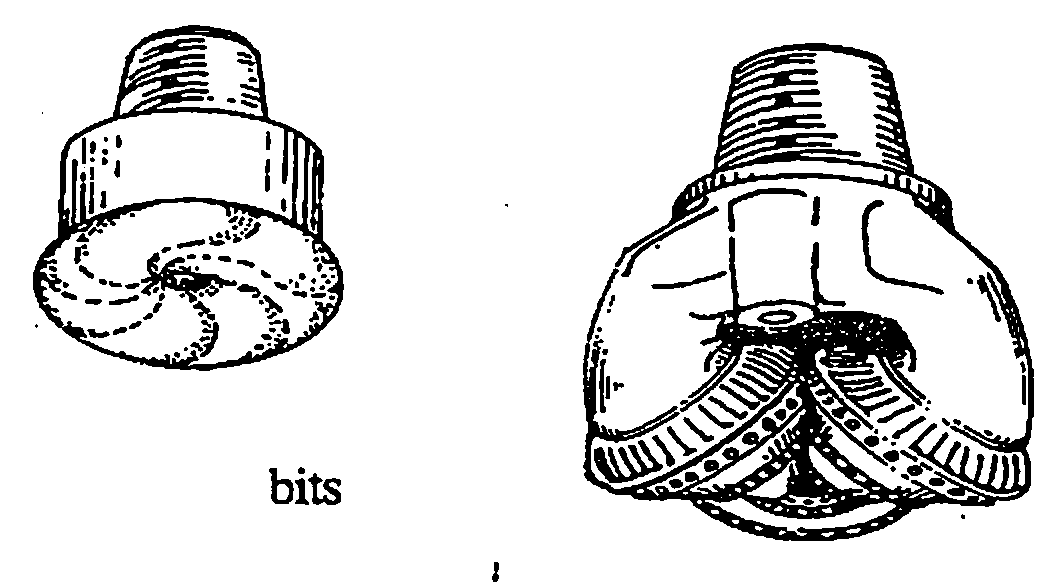
* * *
2. буровое долото; головка бура
* * *
1) долото2) головка бура; буровая коронка3) долото бура; коронка для алмазного бурения4) режущий инструмент; сверло5) бит•bit for underreaming — эксцентрическое долото для расширения скважины;
to break a drilling bit off — отвинчивать буровое долото;
to buildback a drilling bit — восстанавливать буровое долото;
to buildup a drilling bit — восстанавливать буровое долото;
to dress a bit — заправлять долото;
to pick up a drilling bit — приподнимать буровое долото;
to pull a drilling bit — поднимать буровое долото;
- abrasive jet bitto pull a drilling bit green — поднимать буровое долото несработанным;
- abrasive jet coring bit
- air-drilling bit
- air-type bit
- alloy bit
- alloy throw-away bit
- all-purpose bit
- annular bit
- Appleman gumbo bit
- auger bit
- balanced bit
- balanced drilling bit
- ballaset coring bit
- ballaset synthetic diamond bit
- balled-up drilling bit
- basket bit
- bevel-wall bit
- bi-center drilling bit
- big-stone bit
- blade bit
- blade-diamond drilling bit
- blade-drilling bit
- blade-type diamond bit
- blank bit
- blank-casing bit
- blasthole bit
- blind bit
- blunt bit
- blunt drilling bit
- bodiless rolling-cutter drilling bit
- bore bit
- boreway bit
- boring bit
- bort bit
- bort-set bit
- bottom cleanout bit
- bottom discharge bit
- bottoming-type bit
- box-thread bit
- box-type bit
- box-type rolling cutter drilling bit
- broaching bit
- broken-in bit
- bull bit
- bull point drilling bit
- bullnose bit
- burnt bit
- button bit
- button roller bit
- cable drilling bit
- cable tool bit
- California pattern bit
- California-type ideal fishtail bit
- carbide bit
- carbide insert bit
- carbide-type bit
- carboloy-set bit
- carbon bit
- carbonado bit
- carbon-set bit
- carbon-steel bit
- Carr bit
- casing bit
- casing shoe bit
- cast bit
- castellated bit
- cast-insert bit
- cast-set bit
- cavitating jet-assisted mechanical bit
- center bit
- center-hole bit
- chain bit
- changed bit
- chert drilling bit
- chip bit
- chipping-type drilling bit
- chisel bit
- chisel-chopping bit
- chisel-crest insert bit
- chisel-drilling bit
- chisel-type bit
- chopping bit
- chopping drilling bit
- churn-drill bit
- clay bit
- clean-out bit
- collapsible drilling bit
- collaring bit
- combination pilot, drilling and reaming bit
- common bit
- concave bit
- concave diamond drilling bit
- concave plug bit
- cone bit
- cone-and-blade rock drilling bit
- cone-rock bit
- cone-type roller bearing rock bit
- cone-type rolling cutter drilling bit
- conical bit
- convex bit
- core bit
- core-barrel bit
- core-crusher diamond drilling bit
- core-drilling bit
- core-ejector drilling bit
- coreless bit
- coreless drilling bit
- coring bit
- coring drilling bit
- corncob bit
- cross bit
- cross-bladed chisel bit
- cross-chopping bit
- cross-edged bit
- cross-plug bit
- cross-roller bit
- cross-roller rock bit
- cross-section button bit
- cross-section cone bit
- cross-section milled tooth core bit
- cross-section roller core bit
- crown bit
- crowned bit
- cruciform bit
- crushing rock drilling bit
- cutaway wing bit
- cutting-shearing drilling bit
- cutting-type core drilling bit
- cutting-type drilling bit
- Davis cutter bit
- deflecting bit
- deflecting jet drilling bit
- deflection bit
- demountable bit
- demountable drilling bit
- detachable bit
- detachable tungsten carbide insert bit
- deviation control bit
- diamond bit
- diamond-blade drilling bit
- diamond-compact bit
- diamond-compact coring bit
- diamond-core drilling bit
- diamond-crown bit
- diamond-drilling bit
- diamond-drilling core bit
- diamond-impregnated bit
- diamond-insert drilling bit
- diamond-particle bit
- diamond-plug bit
- diamond-point bit
- diamond-point drilling bit
- diamond-set bit
- diamond-set hard metal alloy drilling bit
- differential rolling-cutter drilling bit
- digging bit
- Dimitriyev bit
- disk bit
- double-arc bit
- double-cone bit
- double-cone drilling bit
- double-round nose bit
- double-taper bit
- drag bit
- drag-chisel drilling bit
- drag-drilling bit
- dress bit
- dress drilling bit
- drill bit
- drill-rod bit
- drive bit
- drop-center bit
- dull bit
- dull drilling bit
- dulled drilling bit
- eccentric bit
- eccentric drilling bit
- eccentric underreaming bit
- erosion drilling bit
- even-duty bit
- expandable drilling bit
- expansion bit
- extended insert core bit
- expansion drilling bit
- extended gage bit
- extended nozzle bit
- face-discharge bit
- face-discharge diamond bit
- face-ejection bit
- factory-set bit
- failure bit
- Ferrax journal bit
- finger bit
- finger rotary detachable bit
- finishing bit
- fishtail bit
- fishtail drag bit
- fishtail drilling bit
- flat bit
- flat-face bit
- flat-nose bit
- forged bit
- forged two-wing bit
- four-blade drilling bit
- four-blade rotation bit
- fourble cutter core drilling bit
- four-cone rock drilling bit
- four-cutter rock drilling bit
- four-disk reaming bit
- four-point bit
- four-roller bit
- four-way bit
- four-way drag drilling bit
- four-way rotation bit
- four-wing bit
- four-wing churn drilling bit
- four-wing drag drilling bit
- four-wing drilling bit
- four-wing reaming bit
- four-wing rotary bit
- four-wing rotation bit
- free-falling bit
- fresh bit
- freshly-sharpened bit
- friction bearing bit
- full-gage bit
- full-gage deflecting drilling bit
- full-gage drilling bit
- full-hole bit
- full-hole rock drilling bit
- full-round nose bit
- full-size drilling bit
- geophysical jetting bit
- gimlet bit
- gouge bit
- gravity aspirator bit
- green bit
- gumbo drilling bit
- half-round nose bit
- hand-set bit
- hard-alloy bit
- hard-alloy button drilling bit
- hard-alloy crown bit
- hard-alloy drilling bit
- hard-alloy insert drilling bit
- hard-faced drilling bit
- hard-formation bit
- hard-formation rolling cutter core drilling bit
- hard-metal bit
- hawthorn bit
- heavy-set diamond core drilling bit
- heavy-set diamond drilling bit
- hexagon bit
- high-center bit
- high-pressure bit
- high-pressure diamond bit
- high-pressure drag bit
- high-pressure roller bit
- hollow bit
- hollow drill bit
- Hughes disk bit
- impact action bit
- impregnated bit
- impregnated casing bit
- impregnated diamond drilling bit
- injection drill bit
- insert bit
- insert drilling bit
- insert rock bit
- insert roller core bit
- insert set bit
- insert-type bit
- integral bit
- interchangeable bit
- jack bit
- jet bit
- jet assisted drag bit
- jet assisted roller bit
- jet circulation bit
- jet diamond bit
- jet drilling bit
- jet fishtail drilling bit
- jet hard-alloy insert rolling cutter drilling bit
- jet nozzled rock bit
- jet percussive bit
- jet pump pellet impact drill bit
- jet rock drilling bit
- jet roller bit
- jet rolling cutter drilling bit
- jet two-blade drag bit
- jet two-blade drilling bit
- jet-type tricone bit
- journal-bearing bit
- journal-bearing insert bit
- journal-bearing milled tooth bit
- junk bit
- large-stone bit
- lead bit
- lead drilling bit
- light set bit
- long-inserts bit
- long-shank chopping bit
- long-teeth milled cutter roller core bit
- low-torque drilling bit
- machine-set bit
- machine-sharpened bit
- masonry bit
- massive set diamond bit
- mechanical-set bit
- medium-formation bit
- medium-inserts bit
- medium-round nose bit
- medium-stone bit
- milled-cutter bit
- milled-cutter core bit
- milled-cutter cross section core bit
- milled-teeth drilling bit
- milling bit
- Mother Hubbard bit
- mud bit
- multiblade drilling bit
- multilayer bit
- multilayer diamond drilling bit
- multisector scraping-cutting drilling bit with hard-alloy inserts
- multistone bit
- new bit
- noncoring bit
- off-balance bit
- off-balance drilling bit
- offset chopping bit
- offset cone-angle rolling cutter drilling bit
- oil-field bit
- oil-field rotary bit
- oil-well bit
- oil-well jet bit
- oil-well jet coring bit
- one-cutter rock drilling bit
- opening bit
- oriented diamond bit
- out-of-gage bit
- overburden bit
- overman bit
- oversize drilling bit
- padded bit
- paddle reaming bit
- paddy bit
- paraffin bit
- pellet impact bit
- pencil-core bit
- Pennsylvanian bit
- percussion bit
- percussion-drag drilling bit
- percussion-drilling bit
- percussive coring bit
- pilot bit
- pilot blast-hole bit
- pilot reaming bit
- pineapple drilling bit
- pipe bit
- pipe shoe bit
- placer bit
- plain fishtail drilling bit
- plug bit
- plugged bit
- plugged drilling bit
- pod bit
- pointed drilling bit
- polycrystalline diamond cutter bit
- powder metal bit
- precementing reamer bit
- processed bit
- pyramid-set bit
- quadricone rock drilling bit
- quenched bit
- quill bit
- radial diamond drilling bit
- random set bit
- rathole bit
- reamer bit
- reaming bit
- redrill bit
- Reed roller bit
- removable drill bit
- replaceable bit
- replaceable-blade bit
- replaceable-cutter head bit
- replaceable-head bit
- replacement bit
- rerun drilling bit
- reset bit
- restricted bit
- retractable bit rock
- retracted expandable drilling bit
- reverse circulation drilling bit
- reversed fishtail drilling bit
- reversed two-blade drilling bit
- ring bit
- ringed-out bit
- ripper step bit
- rock bit
- rock bit with lubricant bearing
- rock-cutter drilling bit
- rock-drilling bit
- rock-roller bit
- rod bit
- roller bit
- roller-cone core bit
- roller-cutter core bit
- roller-cutter drilling bit
- rolling cutter expandable drilling bit
- rolling-cutter rock bit
- rose bit
- rotary bit
- rotary core bit
- rotary core drilling bit
- rotary disk bit
- rotary disk drilling bit
- rotary rock bit
- rotation bit
- round-face bit
- round shoulder bit
- rugged bit
- saw bit
- sawtooth bit
- scraping-cutting-type drilling bit
- seal bit
- sealed bearing insert bit
- sealed roller bit
- sectional rolling-cutter drilling bit
- self-cleaning bit
- self-cleaning cone rock drilling bit
- self-cleaning cone rolling cutter drilling bit
- self-sharpening bit
- self-sharpening drilling bit
- semicoring bit
- semiround nose bit
- semispherical bit
- set bit
- sharp bit
- shoe-type washover bit
- shot bit
- shoulder bit
- side-hole bit
- side-tracking bit
- simulated insert bit
- single-bladed bit
- single-chisel bit
- single-layer bit
- single-layer diamond drilling bit
- single-round nose bit
- sintered bit
- sintered diamond bit
- sintered diamond coring bit
- sintered tungsten-carbide teeth drilling bit
- six-cone drilling bit
- six-cutter drilling bit
- six-roller drilling bit
- slip-on bit
- slug bit
- small-stone bit
- smooth bit
- soft-formation bit
- soft-formation insert bit
- soft-formation rolling cutter core drilling bit
- soft-formation tricone bit
- solid bit
- solid concave bit
- solid crown bit
- spade bit
- spark assisted roller drill bit
- spiral bit
- spiral diamond drilling bit
- spiral drilling bit
- spiral whipstock bit
- spoon bit
- spud bit
- spudding drilling bit
- square-nose bit
- square-shoulder bit
- standard core bit
- star bit
- star cable bit
- star pattern drilling bit
- steel bit
- steel-teeth bit
- step bit
- step-core bit
- step-crown bit
- step-face bit
- step-shaped diamond drilling bit
- step-shaped drilling bit
- stepped-crown bit
- straight bit
- straight-chopping bit
- straight-hole bit
- straight-sided core bit
- straight-wall bit
- streamlined waterway bit
- structure bit
- stuck drilling bit
- surface-set bit
- Swedish bit
- taper bit
- tapered bit
- tapered core bit
- tapered socket bit
- tapered step-core bit
- tapered stepped profile bit
- taper-wall bit
- tear-drop set bit
- T-gage bit
- thin-faced bit
- thin-kerf bit
- thin-wall bit
- three-blade drilling bit
- three-cone bit
- three-cone expandable drilling bit
- three-cone rock drilling bit
- three-cutter expandable drilling bit
- three-point bit
- three-point core drilling bit
- three-roller bit
- three-rolling cutter drilling bit
- three-stage drilling bit
- three-way bit
- three-way drilling bit
- three-winged bit
- throw-away bit
- tipped bit
- toothed drilling bit
- toothed roller bit
- torpedo bit
- top hole bit
- tricone bit
- tricone bit with tungsten carbide inserts
- tricone drilling bit
- tricone expandable drilling bit
- tricone jet rock drilling bit
- tricone rock drilling bit
- tricone roller rock bit
- trigger bit
- true-rolling bit
- tungsten-carbide boring bit
- tungsten-carbide drag bit
- tungsten-carbide insert drilling bit
- tungsten-carbide tipped bit
- tungsten-insert bit
- twin-cone bit
- twist bit
- twisted bit
- two-blade drag drilling bit
- two-cone bit
- two-cone drilling bit
- two-cone expandable drilling bit
- two-cutter expandable drilling bit
- two-disk bit
- two-point bit
- two-prong rotary bit
- two-roller bit
- two-way bit
- two-wing drag drilling bit
- unbalanced jet drilling bit
- undergage bit
- underreaming bit
- underweight bit
- unfaced drilling bit
- unstabilized drilling bit
- used bit
- vibrating bit
- wedge bit
- wedge-reaming bit
- wedge-set bit
- wedging bit
- wheel-type drilling bit
- whole-stone bit
- winged scraping bit
- wireline bit
- wireline core drilling bit
- wireline drilling bit
- worn bit
- worn-out drilling bit
- X-bit
- X-shape bit
- Z-bit
- Z-shape bit
- Zublin bit
- Zublin differential bit* * * -
10 motion
1) движение2) механизм•- ballistic electron motion
- Brownian motion
- bubble motion
- chaotic motion
- domain-wall motion
- fast motion
- fault motion
- field-assisted motion
- harmonic motion
- irreversible wall motion
- irreversible domain wall motion
- random motion
- regular motion
- slow motion
- stable motion
- stochastic motion
- vortex motion
- zero-point motion -
11 motion
1) движение2) механизм•- ballistic electron motion
- Brownian motion
- bubble motion
- chaotic motion
- domain-wall motion
- fast motion
- fault motion
- field-assisted motion
- harmonic motion
- irreversible domain wall motion
- irreversible wall motion
- random motion
- regular motion
- slow motion
- stable motion
- stochastic motion
- vortex motion
- zero-point motionThe New English-Russian Dictionary of Radio-electronics > motion
-
12 sample
1) выборка
2) дискрета
3) образец
4) пробный
5) проба
6) отбирать
7) выборный
8) выборочный
9) образчик
10) экземпляр
– air-dry sample
– aligned sample
– allocation of sample
– artificial sample
– averaged sample
– balanced sample
– biased sample
– calcine the sample
– censored sample
– center of sample
– check sample
– cluster sample
– collect sample
– core sample
– cost of a sample
– counter sample
– defective sample
– distribution of a sample
– disturb the sample
– duplicate sample
– equiprobable sample
– exceptional sample
– heat sample
– judgement sample
– judgment sample
– ladle sample
– list sample
– lottery sample
– master sample
– noise sample
– non-random sample
– official sample
– oven-dry sample
– quota sample
– random sample
– range of the sample
– representative sample
– rock sample
– run sample taker
– sample average
– sample bullet
– sample cutting
– sample estimate
– sample flip-flops
– sample mean
– sample of size
– sample piece
– sample range
– sample size
– sample space
– sample spoon
– sample survey
– sample taker
– sample unit
– single sample
– standard sample
– stratified sample
– take sample
– unbiased sample
– unrestricted sample
-
13 work
1) работа; труд; действие; функционирование2) обработка3) обрабатываемая заготовка; обрабатываемая деталь; обрабатываемое изделие4) механизм5) конструкция6) мн. ч. завод; фабрика; мастерские; технические сооружения; строительные работы7) мн. ч. работающие части механизма, подвижные органы механизма8) работать; обрабатывать9) действовать, двигаться, поворачиваться ( о подвижных частях механизмов)10) коробиться•work performed with materials in a smaller quantity — работа, выполненная с недостаточным использованием материалов
work performed without the necessary diligence — работа, выполненная небрежно
work which is not in accordance with specifications — работа, не соответствующая техническим требованиям
work which is not in accordance with the requirements of the engineer — работа, не отвечающая требованиям инженера
to work down — 1) осаживать ( вниз); оседать 2) обрабатывать на меньший размер
to work in — вделывать, вмонтировать
to work into — углубляться во что-либо, уходить внутрь
to work off — 1) соскакивать, соскальзывать ( во время работы) 2) снимать (напр. стружку)
to work on — действовать на что-либо, оказывать влияние на что-либо
to work out — 1) разрабатывать (план, проект) 2) вырабатывать (что-либо) из чего-либо (напр. вытачивать, выстрагивать, выфрезеровывать) 3) выскакивать, выпадать во время работы
to work over — обрабатывать вторично, перерабатывать, подвергать переработке
to work upon — действовать на что-либо, оказывать влияние на что-либо
- work executed - work in process - work of acceleration - work of deformation - work of ideal cycle - work of resistance - work on arbour - works under way - access to works - actual progress of works - amendment of the date of completion of works - amount of the executed works - applied work - asphalt work - assessment of works - auxiliary work - bank work - bargain work - beat-cob work - betterment work - black and white work - bluff work - bonus work - bosh brick work - branch work - branched work - bright work - carpenter's work - cast steel work - cessation of works - chased work - check of works - checking of works - chequer work - chequered work - cindering work - civil works - civil and erection works - clay work - clearing work - commencement of works - completed works - completion of works - concrete work - diversion work - condensing works - construction works - consumed work - continuous execution of works - contract works - cost of works - cost of uncovering works - covered-up works - date of commencement of works - date of completion of works - day-to-day work - day wage work - dead work - defective works - delay in completion of works - delayed completion of works - demolition works - description of works - design and survey works - desilting works - diaper work of bricklaying - drainage work - dredge work - dressing works - drove work - earth works - effective work - embossed work - emergency works - engineering works - erecting works - erection works - examination of works - excavation works - execution of works - expected period of works - extension of the time for completion of works - external work - face work - fascine work - field works - finely finished work - finishing work - fitter's works - flat trellis work - float work - forming work - forthcoming works - frosted rustic work - gauge work - gauged work - geologic works - geological works - grading works - gunite work - heading work - health work - hot work - hydro-meteorologic works - hydro-meteorological works - inadequate progress of works - incomplete lattice work - indicated work - inlaid work - inspection of works - installation work - intake works - irrigation works - jack works - jobbing work - joggle work - ladder work - line work - link work - locksmith's work - machine work - main works - maintenance work - management of works - maritime works - metal work - milling work - motion work - multiple lattice work - nature of works - neat work - negative work - night work - no-load work - odd works - on the site works - order of execution of works - outlet work - outstanding works - overhead works - panel work - partially completed works - part of works - paternoster work - period of works - period of execution of works - permanent works - pilot-scale work - plane frame work - planer work - pneumatic work - port work - portion of works - pottery work - precision work - preliminary works - preparatory works - pressure cementing work - programme of works - progress of works - proper execution of works - prospecting works - public works - pump works - quantity of works - rag work - R and D work - random work - range work - reclamation work - recoverable-strain work - recuperated work - reflected work - reliability of works - relief work - remedial works - repair work - repairing work - required work - research work - resumption of works - retaining works - reticulated work - right of access to works - river training works - rustic work - safety of works - schedule of works - scope of work - shaper work - sheet metal work - shift work - smith and founder work - spillway works - starting work - step-by-step check of works - step-by-step checking of works - stick and rag work - stoppage of works - subcontract works - submarine work - substituted works - sufficiency of works - supervision for works - supervision for of works - survey work - survey and research works - suspension of works - taking over of works - task work - temporary work - test work - test-hole work - three-coat work - through-carved work - time for completion of works - timely completion of works - tool work - topiary work - topographic works - topographical works - track work - treatment works - trellis work - trench work - trestle work - turning work - uncompleted works - uncovering of works - upon completion of works - variations in works - variations of works - volume of works - wiring work - X-ray workto complete works (in the time stipulated in the contract) — завершать работы (в срок, оговорённый в контракте)
* * *1. работа2. изделие3. обработка4. возводимый объект (строительства) ( по подрядному договору); конструкция, сооружение5. работа, мощность6. pl сооружение, сооружения7. pl завод, фабрика, мастерскиеwork above ground — наземные работы ( в отличие от подземных и подводных); работы, производимые на поверхности земли
work below ground ( level) — подземные работы
work carried out on site — работы, выполненные на стройплощадке
work done in sections — работа, выполненная отдельными секциями [частями]
work in open excavations — работы в открытых выемках [горных выработках]
work in progress — (строительные) работы в стадии выполнения, выполняемые [производимые] (строительные) работы; объект в стадии строительства
work in water — работы, производимые в воде [под водой]
work near water — работы, производимые близ водоёмов или рек
- work of deformationwork on schedule — работы в процессе выполнения ( по графику); работы, предусмотренные планом [графиком]
- work of external forces
- work of internal forces
- above-ground works
- additional work
- agricultural works
- alteration work
- ashlar work
- auxiliary work
- avalanche baffle works
- axed work
- backfill work
- backing masonry work
- bag work
- bench work
- block work
- brewery works
- brick work
- broken-color work
- brush work
- building work
- building site works
- carcass work
- carpenter's work
- cement works
- chemical production works
- civil engineering work
- coast protection works
- cob work
- completed work
- complicated building work
- concrete work
- concrete block masonry work
- concrete masonry work
- constructional work
- construction work
- continuous shift work
- contract work
- coursed work
- crib work
- day work
- dead work
- defective work
- defence works
- deformation work
- demolition work
- development work
- diver's works
- diversion works
- donkey work
- drainage works
- earth work
- earth-moving work
- elastic work of a material
- electric work
- electricity production works
- emergency work
- enclosed construction works
- engineering works
- erection work
- erosion protection works
- excavation works
- experimental work
- external work
- extra work
- facing work
- factory work
- fascine work
- finishing work
- finish work
- floating construction works
- flood-control works
- flood-protection works
- floor work
- floor-and-wall tiling work
- floor covering work
- food industry production work
- foundation work
- funerary works
- further day's work
- gas works
- gauged work
- glazed work
- glazier's work
- half-plain work
- hammered work
- hand work
- handy work
- heat insulation work
- heavy work
- highly mechanized work
- hot work
- in-fill masonry work
- innovative construction work
- insulating work
- intake works
- internal work in the system
- ironmongery work
- joinery work
- land retention works
- landslide protection works
- loading works
- manual work
- marine works
- metallurgical processing works
- night work
- nonconforming work
- office work
- off-the-site work
- one-coat work
- open-air intake works
- open construction works
- ornamental works
- ornate work
- outlet works
- overhang work
- overhead work
- permanent works up to ground level
- petroleum extraction works
- piece work
- pitched work
- plaster work
- plumbing work
- power production works
- precast works
- production works
- promotion work
- protection works
- protective works
- public works
- random ashlar work
- refurbishment work
- refuse disposal works
- refuse incineration works
- regulation works
- reinforced concrete work
- research work
- reticulated work
- road transport works
- roof tiling work
- rubble ashlar masonry work
- sanitary works
- sea defence works
- sediment exclusion works
- sewage disposal works
- single construction works
- smillage-axed work
- solid plaster work
- steel construction works
- steel works
- steel plate work
- structural restoration work
- surface transport works
- temporary works
- textile work
- three-coat work
- tiling work
- training works
- transport works
- treatment works
- two-coat work
- underground work
- underwater work
- unloading works
- vermiculated work
- virtual work
- waste disposal works
- water works
- water treatment works -
14 retaining
1) запрудный
2) удерживание
3) тех. контровочный
4) удерживающий
5) сохраняющий
6) сохранение ∙ random walk with retaining barriers ≈ случайное блуждание с поглощающими барьерами water retaining structure ≈ водоподпорное сооружение - retaining contact - retaining ring - retaining rivet - retaining wall удерживающий;
сдерживающий - * bandage (медицина) иммобилизирующая повязка - * device( техническое) арретир, удерживающее устройство - * wall (строительство) подпорная стенка - * party( военное) сковывающая группа - * fee предварительный гонорар адвокатуБольшой англо-русский и русско-английский словарь > retaining
-
15 bond
1) связь; соединение; сцепление || связывать; соединять; сцеплять2) присоединение || присоединять3) связующее ( вещество), связующий материал, связка; крепитель ( вещество)5) строит. антисейсмический пояс6) строп7) электрическое соединение; сращивание проводов10) электрон. выполнять (прикрепление) соединение пайкой или сваркой11) швейн. дублированное (клеевое) соединение•to break ( to fail in) bond — нарушать сцепление-
acceptor bond
-
adhesive bond
-
American bond
-
angle bond
-
atomic bond
-
available bond
-
ball bond
-
basket-weave bond
-
block bond
-
block-in-course bond
-
brick bond
-
bridge bond
-
cable bond
-
carbon-coke bond
-
ceramic bond
-
chain bond
-
chemisorptive bond
-
chimney bond
-
cohesive bond
-
common bond
-
concrete bond
-
conductor bond
-
continuity-rail bond
-
covalent bond
-
cross bond
-
cross-linking bond
-
cross-rail bond
-
dangling bond
-
diagonal bond
-
die bond
-
dipolar bond
-
donor bond
-
double bond
-
Dutch bond
-
energy rich bond
-
English bond
-
English cross bond
-
English garden-wall bond
-
eutectic bond
-
face-down bond
-
face bond
-
Flemish bond
-
frictional bond
-
glassy bond
-
gold bond
-
header bond
-
herringbone bond
-
heteropolar bond
-
high-energy bond
-
homeopolar bond
-
hoop iron bond
-
ice bond
-
impedance bond with secondary winding
-
impedance bond
-
interfacial bond
-
intertrack-rail bond
-
ionic bond
-
ion bond
-
mechanical bond
-
molecular bond
-
nail-head bond
-
ornamental bond
-
oven-wall bond
-
pattern bond
-
planar bonds
-
point bond
-
punch-driven bond
-
quadruple bond
-
quarrystone bond
-
quetta bond
-
rail bond
-
raking bond
-
random bond
-
ranging bond
-
rattrap bond
-
reactance bond
-
refractory bond
-
rope-rail bond
-
running bond
-
sand bond
-
scissile bond
-
Scotch bond
-
semipolar bond
-
silver bond
-
silver-lock bond
-
single bond
-
solder bond
-
solderless bond
-
steel welded bond
-
stitch bond
-
stone bond
-
stretcher bond
-
tar bond
-
track bond
-
traction rail bond
-
triple bond
-
valence bond
-
vulcanization bond
-
wedge bond
-
wire bond
-
wire-rail bond -
16 material
1) материал; вещество2) ткань, материал3) мн. ч. детали ( для обработки)•to calibrate a material — (точно) определять свойства материала-
ablative material
-
abrasive material
-
absorbent material
-
acceptor material
-
acoustical material
-
acoustic material
-
active laser material
-
active material
-
adding material
-
advanced material
-
air-equivalent material
-
air-wall material
-
amorphous magnetic material
-
anisotropic material
-
anodic material
-
antiferroelectric material
-
antiferromagnetic material
-
antifriction material
-
antihalation material
-
antirot material
-
antislip material
-
antisun material
-
asbestos-cement material
-
atmospheric reentry material
-
attached foreign material
-
backfilling material
-
backfill material
-
backing material
-
barrier material
-
base material
-
basic material
-
batch material
-
bed material
-
bimetallic conductor material
-
binding material
-
bituminous material
-
black-and-white material
-
blanket material
-
bonding material
-
borrow material
-
bottoming material
-
bred material
-
breeder material
-
brittle material
-
bubble material
-
building material
-
bulk material
-
bulk semiconductor material
-
burden material
-
carbon electrical material
-
carrier material
-
case material
-
cast stone material
-
caved material
-
cementing material
-
ceramic foam material
-
ceramic material
-
charge material
-
charging material
-
clad dielectric material
-
clad material
-
coal-tar raw material
-
coating material
-
coherent material
-
cohesionless material
-
cohesive material
-
coiled material
-
cold-charged material
-
color material
-
combustible material
-
combustion materials
-
compact material
-
composite material
-
compounding material
-
concrete materials
-
conducting material
-
conductor material
-
constant bandgap material
-
constructional material
-
contact conductor material
-
core material
-
corrosion-resistance material
-
cover material
-
covering material
-
crib material
-
crucible material
-
crystalline material
-
cushioning material
-
damping material
-
degenerative semiconductor material
-
diamagnetic material
-
dielectric material
-
difficult-to-cut material
-
diffusion transfer material
-
direct bandgap material
-
discrete material
-
disordered material
-
dolomite-based material
-
dopant material
-
doping material
-
dredged material
-
ductile material
-
dye bleach material
-
earthy raw materials
-
elastic material
-
electret material
-
electric contact material
-
electric insulating material
-
electrochromic material
-
electrode material
-
electroluminescent material
-
electronic-grade material
-
electronic material
-
electrooptical material
-
electrooptic material
-
electrostrictive material
-
electrotechnical material
-
ENG/EFP tape material
-
engineering material
-
epitaxial material
-
evaporated material
-
evaporation material
-
excavated material
-
excessive uncut material
-
expanded material
-
explosive material
-
extraneous material
-
extraterrestrial material
-
extrinsic material
-
fabric-filled molding material
-
facing material
-
feed material
-
ferrimagnetic material
-
ferroelectric material
-
ferromagnetic material
-
ferrous material
-
fertile material
-
fettling material
-
fiber glass material
-
fiber-filled molding material
-
fiber-forming material
-
fiber-reinforced material
-
fibrous material
-
filling material
-
finished material
-
finishing material
-
fireclay material
-
fired material
-
fireproof material
-
fire-resistant material
-
fissile material
-
fissionable material
-
fission material
-
flammable material
-
float material
-
fluxing material
-
foam material
-
foam-type refractory material
-
food raw material
-
foreign material
-
foundation material
-
frost-resistant material
-
fuel material
-
fungicidal packaging material
-
gaseous fissionable material
-
gasket material
-
glass-bonded reinforced dielectric material
-
glass-bonded dielectric material
-
glass-ceramic material
-
glass-fiber material
-
glass-forming material
-
graded bandgap material
-
granular material
-
greasy material
-
grinding material
-
gunned material
-
half-finished material
-
hard material
-
hard-magnetic material
-
hard-to-machine material
-
heat-insulating material
-
heat-resistant material
-
heat-resisting conductor material
-
heat-resisting material
-
heat-softenable material
-
heat-transfer material
-
high-alloy material
-
high-coercivity material
-
high-conductivity material
-
high-definition material
-
high-expansion material
-
high-performance material
-
high-resistivity material
-
high-resolution material
-
high-Z material
-
honeycombed material
-
honeycomb material
-
host material
-
hot material
-
hydraulic insulating material
-
hydrocarbon material
-
hyperconductor material
-
ideal granular material
-
imaging material
-
incombustible material
-
inedible raw material
-
inedible material
-
inert material
-
inflammable material
-
in-process material
-
insulating material
-
intergranular material
-
intermediate material
-
intrinsic material
-
isotropic material
-
jointing material
-
joint-sealing material
-
laminated material
-
large-gap material
-
laser material
-
lasing material
-
library material
-
light-sensitive material
-
linearly elastic material
-
lining material
-
liquid fissionable material
-
loading material
-
loose material
-
lossy material
-
lost circulation material
-
low-bandgap material
-
low-gap material
-
low-coercitivity material
-
low-expansion material
-
low-loss material
-
low-mobility photovoltaic material
-
low-resistivity material
-
lump material
-
magnetic material
-
magnetically hard material
-
magnetically soft material
-
magnetodielectric material
-
magnetooptic material
-
magnetostrictive material
-
man-made material
-
materials of construction
-
metallic conductor material
-
metallic material
-
mine-run material
-
minus material
-
molding material
-
monocrystalline material
-
multicorrugating material
-
multilayer conductor material
-
multilayer material
-
narrow-bandgap material
-
natural material
-
negative electron affinity material
-
negative material
-
negative-image material
-
nonabrasive material
-
noncoherent material
-
noncombustible material
-
nonconductivity material
-
nonfired material
-
nonflammable material
-
nonfood raw material
-
nonmagnetic material
-
nonretentive material
-
nonsilver material
-
nonterrestrial material
-
n-type material
-
nuclear material
-
oil-resistant material
-
optical material
-
oversize material
-
oxide-metal material
-
packaging material
-
packing material
-
paintwork material
-
paramagnetic material
-
parent material
-
patching material
-
pavement material
-
paving material
-
phosphor material
-
photochromic material
-
photoconductive material
-
photographic material
-
photoresponsive material
-
photosensitive material
-
phototropic material
-
photovoltaic material
-
piezoelectric material
-
plastic material
-
polycrystalline material
-
poromeric material
-
positive electron affinity material
-
positive material
-
positive-image material
-
preformed material
-
pressure sensitive material
-
prestrained material
-
p-type material
-
pulp-making material
-
pyroelectric material
-
ramming material
-
random material
-
rapid-access photographic material
-
raw material
-
receiving material
-
recording material
-
recycled material
-
reference nuclear materials
-
refractory conductor material
-
refractory material
-
reject material
-
rejected material
-
resistance material
-
resistive material
-
retentive material
-
returned fissile material
-
reversal material
-
road-building material
-
roll material
-
roll-compacted powder material
-
rooting material
-
rough material
-
rubber-cord material
-
rubber-like material
-
rubber-reinforced material
-
rubbery material
-
sandwiched material
-
scrap material
-
sealing material
-
secondary hardening material
-
secondary raw materials
-
self-adhesive material
-
self-developing material
-
semiconducting material
-
semiconductive material
-
semisolid bituminous materials
-
sensitive material
-
sheet material
-
shielding material
-
silicate concrete material
-
silverless material
-
sintered material
-
sintered metal-powder material
-
slagging material
-
slip-cast material
-
soft material
-
soft-magnetic material
-
solar energy storage material
-
solid bituminous material
-
solid fissionable material
-
solid-foamed material
-
solvent-resistant material
-
sound-absorbing material
-
sound-insulating material
-
space-manufactured material
-
spalling-resistant material
-
special fissionable material
-
square-loop material
-
standard nuclear materials
-
starting material
-
stealth material
-
stemming material
-
stowing material
-
structural material
-
superconducting material
-
superconductive material
-
superrefractory material
-
surface-active material
-
surface-inactive material
-
tamping material
-
tar-dolomite material
-
tar-stabilized dolomite material
-
temperature sensitive material
-
termination material
-
textured material
-
thermographic material
-
thermomagnetic material
-
thermosetting material
-
thermost material
-
timber-based material
-
tool material
-
tree-length material
-
two-gap material
-
two-valley material
-
ultrarefractory material
-
unclad dielectric material
-
undersize material
-
upholstery material
-
vaporproof material
-
vesicular material
-
video material
-
vitrocrystalline material
-
wall-building material
-
washing material
-
waste material
-
waterproofing material
-
web material
-
weighting material
-
widebandgap material
-
widegap material
-
wood raw material
-
work material -
17 law
nounзакон m, закон распределенияBorel zero-one law борелевский критерий/закон нуля-единицыbounded law of the iterated logarithm ограниченный закон повторного логарифмаChung's law of the iterated logarithm закон повторного логарифма в форме Чжунаcompact law of the iterated logarithm компактный закон повторного логарифмаconvergence in law сходимость f по распределениюdomain of partial attraction of an infinitely divisible law область f частичного притяжения безгранично делимо- го законаGaussian law гауссов-ский/нормальный законStrassen's law of the iterated logarithm закон повторного логарифма в форме ШтрассенаАнглийский-русский словарь по теории вероятностей, статистике и комбинаторике > law
-
18 effect
1) эффект; явление || производить эффект; порождать явление2) влияние; (воз)действие || влиять; оказывать влияние; (воз)действовать; оказывать воздействие3) pl тлв вчт спецэффекты•- ac Hall effect
- ac Josephson effect
- acoustical Faraday effect
- acoustic Doppler effect
- acoustoelectric effect
- acoustoresistive effect
- ambisonic effect
- anisotropic effect
- anode effect
- anomalous Hall effect
- anomalous Sasaki-Shibuya effect
- anomalous Zeeman effect
- antenna effect
- aspect effect
- atomic photoelectric effect
- Auger effect
- avalanche effect
- background effect
- back-porch effect
- back stress effect
- back-wall photoelectric effect
- Barkhausen effect
- Barnett effect
- barrier effect
- base-robbing effect
- binaural effect
- blackout effect
- blindness effect
- Boers effect
- Bragg effect
- Bridgman effect
- bulk effect
- Burstein-Moss effect
- butterfly effect
- capture effect
- Casimir effect
- Cerenkov effect
- channel effect
- charge-storage effect
- cocktail-party effect
- collector-follower effect
- colossal magnetoresistive effect
- comet effect
- Compton effect
- conductivity modulation effect
- contour effect
- conventional skin effect
- converse effect
- converse magnetostrictive effect
- Cooper effect
- Corbino effect
- corner effect
- corona effect
- Cotton effect
- Cotton-Mouton effect
- cryptomagnetic effect
- dc Hall effect
- dc Josephson effect
- dead-end effect
- Debye effect
- Debye-Sears effect
- delayed-sidetone effect
- Dellinger effect
- Dember effect
- dephasing effect
- Destriau effect
- digital multi-effects - domino effect
- Doppler effect
- dynamic pinch effect
- dynamic stereoscopic effect
- dynatron effect
- Early effect
- echo effect
- edge effect
- Edison effect
- Einstein-de Haas effect
- elastooptical effect
- elastoresistive effect
- electroacoustic effect
- electrooptical effect
- electrooptical Kerr effect
- electro-opto-acoustical effect
- electroosmotic effect
- electrophonic effect
- electrophoretic effect
- electroresistive effect
- electrostatic Kerr effect
- electrostrictive effect
- emitter dip effect
- emitter push effect
- end effect
- equatorial Kerr effect
- equatorial magnetooptical Kerr effect
- Esaki effect
- Ettingshausen effect
- external photoelectric effect
- extrinsic photoconductive effect
- extrinsic photoelectric effect
- Faraday effect
- ferroelectric effect
- ferromagnetic proximity effect
- field effect
- field-rejection effect
- fixed effects
- flexoelectric effect
- flicker effect
- flywheel effect
- forbidden effect
- fractional quantum Hall effect
- fringe effect
- galvanomagnetic effects
- galvanothermomagnetic effects
- gap effect
- Gauss effect
- giant Hall effect
- giant magnetoimpedance effect
- giant magnetoresistive effect
- granularity effect
- greenhouse effect
- Gudden-Pohl effect
- Gunn effect
- gyromagnetic effects
- Haas effect
- Hall effect
- Hallwachs effect
- Hanle effect
- heating effect of current
- height effect
- hole-burning effect
- hyperfine effect
- image effect
- inlay effect
- interface effects
- internal photoelectric effect
- intrinsic photoconductive effect
- invar effect
- inverse effect
- inverse Faraday effect
- inverse photoelectric effect
- inverse piezoelectric effect
- island effect
- isotope effect
- Jahn-Teller effect
- Josephson effect
- Joule effect
- junction edge effect
- Kapitza-Dirac effect
- Kerr effect
- Kirk effect
- Kirkendall effect
- Kundt effect
- lagged effect
- laser effect
- Leduc-Righi effect
- linear electrooptic effect
- longitudinal galvanothermomagnetic effect
- longitudinal Kerr effect
- longitudinal magnetoresistive effect
- longitudinal thermomagnetic effect
- long-line effect
- long-run effect
- Lorentz effect
- Lossev effect
- Luxemburg effect
- Maggi-Righi-Leduc effect
- magnetoelastic effect
- magnetoelectric effect
- magnetogalvanic effects
- magnetoimpedance effect
- magnetooptical Kerr effect
- magnetoresistive effect
- magnetostrictive effect
- magnetron effect
- Malter effect
- Meisner effect
- meridional Kerr effect
- meridional magnetooptical Kerr effect
- metamagnetic effect
- metamagnetoelastic effect
- microphonic effect
- microwave biological effect
- Miller effect
- moiré effect
- Mössbauer effect
- motor effect
- multipactor effect
- multipath effect
- multi-valued Sasaki-Shibuya effect
- mutual coupling effect on input impedance
- mutual coupling effect on radiation pattern
- negative resistance effect
- Nernst effect
- Nernst-Ettingshausen effect
- night effect
- normal Hall effect
- normal Zeeman effect
- Nottingham effect
- Ovshinsky effect
- pairing effect
- parallel pumping instability effect
- parallel pumping spin wave instability effect
- Pashen-Back effect
- peak effect
- Peltier effect
- photocapacitor effect
- photoconductive effect
- photodielectric effect
- photodiffusion effect
- photoelastic effect
- photoelectret effect
- photoelectric effect
- photoelectromagnetic effect
- photoemissive effect
- photomagnetic effect
- photomagnetoelectric effect
- photopiezoelectric effect
- photothermoelectric effect
- photovoltaic effect
- picket-fence effect
- piezoelectric effect
- piezomagnetic effect
- piezomagnetoelectric effect
- piezooptical effect
- piezoresistance effect
- piezoresistive effect
- pinch effect
- pinch-in effect
- Pockels effect
- polar Kerr effect
- polar magnetooptical Kerr effect
- Pool-Frenkel effect
- print-through effect
- proximity effect
- pyroelectric effect
- pyromagnetic effect
- quadraphonic effect
- quadro effect
- quadratic magnetooptical effect
- quantized Hall effect
- quantum Hall effect
- Raman effect
- Ramsauer effect
- random effect
- rate effect
- red eyes effect
- Renner effect
- Richardson effect
- Ridley-Watkins-Hilsum-Gunn effect
- Righi-Leduc effect
- Rijke effect
- ripple effect
- ripple-through effect
- Rocky-Point effect
- S-effect
- Sasaki-Shibuya effect
- Schottky effect
- schrot effect
- screening effect
- seasonal effect
- Seebeck effect
- shore effect
- short-channel effect
- short-run effect
- shot effect
- side effect
- sidewalk effect
- Silsbee effect
- size effect
- skin effect
- sound effects
- space-charge effect
- special effects
- speckle effect
- spillover effect
- Stark effect
- stereo effect
- stereophonic effect
- stereoscopic effect
- Stiles-Crawford effect
- stimulated Raman effect
- stirring effect
- storage effect
- stroboscopic effect
- Stroop effect
- Suhl effect
- superparamagnetic effect
- surface-charge effect
- surface field effect
- tensoresistive effect
- tertiary pyroelectric effect
- thermal effect
- thermoelectric effect
- thermogalvanomagnetic effect
- thermomagnetic effect
- Thomson effect
- threshold effect
- transferred-electron effect
- transverse galvanothermomagnetic effect
- transverse Hall effect
- transverse Kerr effect
- transverse magnetoresistive effect
- transverse Nernst-Ettingshausen effect
- transverse pumping instability effect
- transverse pumping spin wave instability effect
- transverse thermogalvanomagnetic effect
- transverse thermomagnetic effect
- trap effect
- trapping effect
- tunnel effect
- tunneling effect
- turnpike effect
- twisted nematic effect
- Tyndall effect
- Venetian blind effect
- vertical component effect
- Villari effect
- Voigt effect
- Volta effect
- wall effect
- Webster effect
- Wertheim effect
- Wiedemann effect
- Wiegand effect
- window effect
- word superiority effect
- X-ray photoelectric effect
- Zeeman effect
- Zener effect
- ΔE-effect -
19 logic
в) логическая схема; логические схемы- active logic
- application logic
- assertion-level logic - base-coupled logic
- binary logic
- bipolar logic
- bit-serial logic
- bubble logic
- buffered logic
- buried-load logic
- business logic
- cache logic
- cellular logic
- charge-coupled logic
- charge-coupled device logic
- chroma invert logic
- clocked logic
- closed C-MOS logic
- collector-coupled logic
- combination logic
- compatible logic - complementary transistor-resistor logic
- computer logic
- control logic
- core logic
- core-transistor logic
- current-hogging logic - current-mode logic
- current-sinking logic
- current-sourcing logic
- degating logic
- designer choice logic - double-railed logic
- dynamic logic - emitter-function logic
- extensional logic
- field-effect transistor logic
- first-order logic
- first-order predicate logic
- formal logic
- full logic
- functional logic
- fuse-programmable array logic
- fuzzy logic
- glue logic - hardware logic
- hard-wired logic
- high-level logic - integrated-circuit logic - latching logic
- local-control logic
- locked-pair logic
- look-ahead carry logic - low-voltage logic - magnetic domain-wall logic
- magnetoelectronic logic
- magnetooptical logic
- majority logic
- mathematical logic - micropower logic
- microwatt logic
- microwave logic
- modal logic
- multiaperture-device logic
- multiemitter-transistor logic
- multilevel logic
- multiphase logic
- multitarget acquisition logic
- multivalued logic
- nanosecond logic
- negative logic
- neighborhood logic - n-level logic
- one-line delay logic
- operation logic
- optical logic
- optoelectronic logic
- pass-transistor logic
- positive logic
- positive true logic
- predicate logic
- programmable logic
- programmable array logic
- quadded logic
- Rambus signaling logic
- random logic
- rapid single flux quantum logic
- reacquisition logic
- Reed-Müller logic
- register transfer logic - resistor-coupled transistor logic - sampling-type logic
- saturated logic
- save-carry logic - Schottky transistor-transistor logic - shared logic
- solid logic
- solid-state logic
- standard logic
- static logic
- stored logic - ternary logic
- tertiary logic
- threshold logic
- tightly-packed logic
- track monitoring logic
- transistor logic - tunnel-diode logic - virtual logic
- voltage-stage logic
- wired program logic -
20 effect
1) эффект; явление || производить эффект; порождать явление2) влияние; (воз)действие || влиять; оказывать влияние; (воз)действовать; оказывать воздействие3) pl.; тлв.; вчт. спецэффекты•- ac Hall effect
- ac Josephson effect
- acoustic Doppler effect
- acoustical Faraday effect
- acoustoelectric effect
- acoustoresistive effect
- ambisonic effect
- anisotropic effect
- anode effect
- anomalous Hall effect
- anomalous Sasaki-Shibuya effect
- anomalous Zeeman effect
- antenna effect
- aspect effect
- atomic photoelectric effect
- Auger effect
- avalanche effect
- back stress effect
- background effect
- back-porch effect
- back-wall photoelectric effect
- Barkhausen effect
- Barnett effect
- barrier effect
- base-robbing effect
- binaural effect
- blackout effect
- blindness effect
- Boers effect
- Bragg effect
- Bridgman effect
- bulk effect
- Burstein-Moss effect
- butterfly effect
- capture effect
- Casimir effect
- Cerenkov effect
- channel effect
- charge-storage effect
- cocktail-party effect
- collector-follower effect
- colossal magnetoresistive effect
- comet effect
- Compton effect
- conductivity modulation effect
- contour effect
- conventional skin effect
- converse effect
- converse magnetostrictive effect
- Cooper effect
- Corbino effect
- corner effect
- corona effect
- Cotton effect
- Cotton-Mouton effect
- cryptomagnetic effect
- dc Hall effect
- dc Josephson effect
- dead-end effect
- Debye effect
- Debye-Sears effect
- delayed-sidetone effect
- Dellinger effect
- Dember effect
- dephasing effect
- Destriau effect
- digital multi-effects
- digital video effect
- direct piezoelectric effect
- domino effect
- Doppler effect
- dynamic pinch effect
- dynamic stereoscopic effect
- dynatron effect
- Early effect
- echo effect
- edge effect
- Edison effect
- effect of intermediate valence
- Einstein-de Haas effect
- elastooptical effect
- elastoresistive effect
- electroacoustic effect
- electrooptical effect
- electrooptical Kerr effect
- electro-opto-acoustical effect
- electroosmotic effect
- electrophonic effect
- electrophoretic effect
- electroresistive effect
- electrostatic Kerr effect
- electrostrictive effect
- emitter dip effect
- emitter push effect
- end effect
- equatorial Kerr effect
- equatorial magnetooptical Kerr effect
- Esaki effect
- Ettingshausen effect
- external photoelectric effect
- extrinsic photoconductive effect
- extrinsic photoelectric effect
- Faraday effect
- ferroelectric effect
- ferromagnetic proximity effect
- field effect
- field-rejection effect
- fixed effects
- flexoelectric effect
- flicker effect
- flywheel effect
- forbidden effect
- fractional quantum Hall effect
- fringe effect
- galvanomagnetic effects
- galvanothermomagnetic effects
- gap effect
- Gauss effect
- giant Hall effect
- giant magnetoimpedance effect
- giant magnetoresistive effect
- granularity effect
- greenhouse effect
- Gudden-Pohl effect
- Gunn effect
- gyromagnetic effects
- Haas effect
- Hall effect
- Hallwachs effect
- Hanle effect
- heating effect of current
- height effect
- hole-burning effect
- hyperfine effect
- image effect
- inlay effect
- interface effects
- internal photoelectric effect
- intrinsic photoconductive effect
- invar effect
- inverse effect
- inverse Faraday effect
- inverse photoelectric effect
- inverse piezoelectric effect
- island effect
- isotope effect
- Jahn-Teller effect
- Josephson effect
- Joule effect
- junction edge effect
- Kapitza-Dirac effect
- Kerr effect
- Kirk effect
- Kirkendall effect
- Kundt effect
- lagged effect
- laser effect
- Leduc-Righi effect
- linear electrooptic effect
- longitudinal galvanothermomagnetic effect
- longitudinal Kerr effect
- longitudinal magnetoresistive effect
- longitudinal thermomagnetic effect
- long-line effect
- long-run effect
- Lorentz effect
- Lossev effect
- Luxemburg effect
- Maggi-Righi-Leduc effect
- magnetoelastic effect
- magnetoelectric effect
- magnetogalvanic effects
- magnetoimpedance effect
- magnetooptical Kerr effect
- magnetoresistive effect
- magnetostrictive effect
- magnetron effect
- Malter effect
- Meisner effect
- meridional Kerr effect
- meridional magnetooptical Kerr effect
- metamagnetic effect
- metamagnetoelastic effect
- microphonic effect
- microwave biological effect
- Miller effect
- moiré effect
- Mössbauer effect
- motor effect
- multipactor effect
- multipath effect
- multi-valued Sasaki-Shibuya effect
- mutual coupling effect on input impedance
- mutual coupling effect on radiation pattern
- negative resistance effect
- Nernst effect
- Nernst-Ettingshausen effect
- night effect
- normal Hall effect
- normal Zeeman effect
- Nottingham effect
- Ovshinsky effect
- pairing effect
- parallel pumping instability effect
- parallel pumping spin wave instability effect
- Pashen-Back effect
- peak effect
- Peltier effect
- photocapacitor effect
- photoconductive effect
- photodielectric effect
- photodiffusion effect
- photoelastic effect
- photoelectret effect
- photoelectric effect
- photoelectromagnetic effect
- photoemissive effect
- photomagnetic effect
- photomagnetoelectric effect
- photopiezoelectric effect
- photothermoelectric effect
- photovoltaic effect
- picket-fence effect
- piezoelectric effect
- piezomagnetic effect
- piezomagnetoelectric effect
- piezooptical effect
- piezoresistance effect
- piezoresistive effect
- pinch effect
- pinch-in effect
- Pockels effect
- polar Kerr effect
- polar magnetooptical Kerr effect
- Pool-Frenkel effect
- print-through effect
- proximity effect
- pyroelectric effect
- pyromagnetic effect
- quadraphonic effect
- quadratic magnetooptical effect
- quadro effect
- quantized Hall effect
- quantum Hall effect
- Raman effect
- Ramsauer effect
- random effect
- rate effect
- red eyes effect
- Renner effect
- Richardson effect
- Ridley-Watkins-Hilsum-Gunn effect
- Righi-Leduc effect
- Rijke effect
- ripple effect
- ripple-through effect
- Rocky-Point effect
- S effect
- Sasaki-Shibuya effect
- Schottky effect
- schrot effect
- screening effect
- seasonal effect
- Seebeck effect
- shore effect
- short-channel effect
- short-run effect
- shot effect
- side effect
- sidewalk effect
- Silsbee effect
- size effect
- skin effect
- sound effects
- space-charge effect
- special effects
- speckle effect
- spillover effect
- Stark effect
- stereo effect
- stereophonic effect
- stereoscopic effect
- Stiles-Crawford effect
- stimulated Raman effect
- stirring effect
- storage effect
- stroboscopic effect
- Stroop effect
- Suhl effect
- superparamagnetic effect
- surface field effect
- surface-charge effect
- tensoresistive effect
- tertiary pyroelectric effect
- thermal effect
- thermoelectric effect
- thermogalvanomagnetic effect
- thermomagnetic effect
- Thomson effect
- threshold effect
- transferred-electron effect
- transverse galvanothermomagnetic effect
- transverse Hall effect
- transverse Kerr effect
- transverse magnetoresistive effect
- transverse Nernst-Ettingshausen effect
- transverse pumping instability effect
- transverse pumping spin wave instability effect
- transverse thermogalvanomagnetic effect
- transverse thermomagnetic effect
- trap effect
- trapping effect
- tunnel effect
- tunneling effect
- turnpike effect
- twisted nematic effect
- Tyndall effect
- Venetian blind effect
- vertical component effect
- Villari effect
- Voigt effect
- Volta effect
- wall effect
- Webster effect
- Wertheim effect
- Wiedemann effect
- Wiegand effect
- window effect
- word superiority effect
- X-ray photoelectric effect
- Zeeman effect
- Zener effectThe New English-Russian Dictionary of Radio-electronics > effect
См. также в других словарях:
Random House — Random House, Inc. Type Division of Bertelsmann Industry Books, Publishing Founded … Wikipedia
Wall Street — is a street in lower Manhattan, New York City, United States. It runs east from Broadway to South Street on the East River, through the historical center of the Financial District. Wall Street was the first permanent home of the New York Stock… … Wikipedia
Random walk hypothesis — The random walk hypothesis is a financial theory stating that stock market prices evolve according to a random walk and thus the prices of the stock market cannot be predicted. It has been described as jibing with the efficient market hypothesis … Wikipedia
Random-access memory — RAM redirects here. For other uses of the word, see Ram (disambiguation). Example of writable volatile random access memory: Synchronous Dynamic RAM modules, primarily used as main memory in personal computers, workstations, and servers … Wikipedia
Wall Street Spin — Infobox Game subject name = Wall Street Spin image link = image caption = players = 2–6 ages = 10 and up setup time = 3 minutes playing time = 1 1.5 hours complexity = medium low strategy = medium random chance = high skills = Math, Strategy,… … Wikipedia
Random House Tower — 40° 45′ 55″ N 73° 58′ 57″ W / 40.765341, 73.982502 … Wikipédia en Français
Random Walk Theory — The theory that stock price changes have the same distribution and are independent of each other, so the past movement or trend of a stock price or market cannot be used to predict its future movement. In short, this is the idea that stocks take… … Investment dictionary
A Random Walk Down Wall Street — Infobox Book name = A Random Walk Down Wall Street author = Burton Malkiel genre = Finance language = English publisher = W. W. Norton Company, Inc. release date = 1973 pages = 456 isbn = ISBN 0 393 06245 7 A Random Walk Down Wall Street ,… … Wikipedia
Hadrian's Wall — This article is about the fortification in Northern England. For the Broad Wall of Jerusalem, see Broad Wall (Jerusalem). Coordinates: 55°01′27″N 2°17′33″W / 55.02417°N 2 … Wikipedia
Off the Wall (album) — Off the Wall Studio album by Michael Jackson Released August 10, 1979 … Wikipedia
Off the Wall — Студийный аль … Википедия
